
Official FAQ
Riftbound Origins FAQ
Official FAQ covering card rulings, clarifications, and rules context linked to 91 cards on RiftRef.
View official sourceScoring
Q: How do I score? How are conquer and hold different?
When you take control of a battlefield you didnʼt already control and which you havenʼt scored yet this turn, you score 1 point. This is called conquering.
If you control a battlefield at the start of your turn, you score 1 point. This is called holding.
Q: How does the last point work?
In order to win the game, you need to score the last point (the 8th point in most games, 11th in 2v2). If you try to score the last point by conquering, you will only get the last point if you have already scored all of the other battlefields this turn. Otherwise, youʼll draw a card instead.
So, in an 8 point 1v1 game with two battlefields:
- If you are at 6 points and conquer both battlefields, youʼll go to 7 and then to 8 and win.
- If you are at 7 points and conquer both battlefields, youʼll draw a card for the first one, and then go to 8 and win.
- If you are at 6 points, hold one battlefield to 7, and conquer the other to go to 8 and win.
If you are at 7 points, you can hold one to go to 8 and win. In an 8 point 4 player Free-for-All game with three battlefields:
- If you are at 5 points and conquer all 3 battlefields, youʼll go to 6 then 7 then 8 and win.
- If you are at 6 points and conquer all 3 battlefields, youʼll go to 7 then draw 1, then 8 and win.
- If you are at 5 points, hold 1 battlefield to 6, then conquer the other two, youʼll go to 7 and then 8 and win.
Movement
Q: Whatʼs the standard move?
Every unit has the natural ability to move itself from base to battlefield, or back from battlefield to base, during your Main Phase (on your own turn, outside of a showdown). To do this, you pay the cost (exhausting the unit) and then move the unit. If a unit is exhausted, you canʼt move it using the standard move.
Q: Do I have to exhaust a unit when I move it with a spell or ability?
Moving a unit with a spell or ability wonʼt change its ready or exhausted state unless the effect specifies that it does. The cost of using a unitʼs standard move is to exhaust that unit, but that isnʼt a cost or effect of other moves.
Q: Can I move multiple units together to a battlefield?
Yes, you can use the standard move of your units all at once to move them as a group together to the same legal destination. To do this, exhaust them all (the cost of the standard move) and then move them to the destination, then resolve any move effects, then start a showdown if needed.
Q: Does Ganking allow a unit to move an extra time? When can I use the Ganking ability?
No, Ganking is an extra way to use the standard move. Normally, when a unit uses the standard move, it can only move between base and battlefield. If a unit has Ganking, it can also move between two battlefields. You can move units with Ganking alongside other units that are moving with the standard move, as long as the destination is legal for all units moving as a group.
Q: Can I move more units in before a combat starts using a spell or ability?
If you donʼt move units together as a group using the standard move, then you can only move additional units afterward if you use a spell or ability with the Action or Reaction keywords, after the combat starts as part of the showdown.
Combat
Q: What happens when both sides in combat have the same total Might?
In this case, both sides will assign damage to the other side equal to the total Might of all units there, which will end up killing all units on both sides. No units will remain to control the battlefield, leaving it open and nobody will score a point.
Q: What happens if units from both sides in combat survive, either because of Kayn or a stun?
In this case, both sides will still assign damage to the other side as normal (stunned units will not deal damage). Units will still die if they are assigned damage equal to or greater than their Might (unless they donʼt die, for example because of Kaynʼs ability). Then if units from both sides remain alive at the battlefield, any remaining attacking units will be recalled to base and the defending player will maintain control (no score, though).
Q: Do units heal from combat damage? When?
Yes, units everywhere will heal from damage at the end of every combat and at the end of every turn. That means if a unit survives through damage assignment, itʼll be back to zero damage at the end of the combat.
Resources
Q: How do runes work? What are energy and power? Can I recycle an exhausted rune?
Yes, each rune has two abilities, and you can use both of them in the same turn:
- You can exhaust a rune to produce 1 energy. Energy is used to pay numerical costs, and doesnʼt have a domain/color associated with it, even though the runes used to generate it do.
- You can recycle a rune (even an exhausted one) to produce 1 power of that runeʼs domain/color. Power is used to pay color symbol costs.
Rune abilities have the Reaction keyword, which means they can be used anytime.
Q: Is there a limit to how many runes I can have?
Yes, all Riftbound decks are built with exactly 12 runes, so once you have channeled all of them, you canʼt get more runes on the board.
Q: Do Seals add energy? Do Seals enter exhausted like units do?
No, Seals canʼt generate energy. They can be exhausted to produce 1 power of Sealʼs domain/color. Since you donʼt recycle them to make the power resource, you will be able to ready them and use them again on future turns.
Q: How much do I pay for an Accelerate cost?
Accelerate costs 1 energy and also 1 power of the unitʼs domain/color. Usually youʼll do this by taking an additional ready rune of the appropriate domain/color, exhaust it, and then recycle that same rune. For example, if a fury/red unit normally costs [3] (or 3 energy) and you want to accelerate it, its total cost would be [4][R] (or 4 energy and 1 power of the fury/red domain).
Keywords
Q: What does Mighty mean?
A unit is Mighty if it has 5 or more Might. Units donʼt have the keyword "Mighty"-as long as a unit has 5 or more Might, the unit is Mighty. When you play a unit with 5 or more Might, you can exhaust your Relentless Storm Legend to channel a rune exhausted.
Q: Do I get my Legion effect when I play a token or use an ability?
No, Legion will only be active if youʼve played a card this turn. Tokens are not cards, and abilities arenʼt either.
Hidden
Q: How do I hide a card with Hidden?
You can hide a card with the Hidden keyword from your hand instead of paying its normal cost. To do this, you must already control a battlefield (have units there) to hide the card at. Hiding a card costs [A] (one power of any domain/color) and you place the card face down at that battlefield.
Q: When I hide a card, does that count for Legion?
Hiding isn't playing, and doesn't count as playing a card for abilities like Legion.
Q: If I hide a card, and then my opponent uses a spell to move a unit to that battlefield that same turn, can I play the card I hid?
No. You can't play cards the same turn you hide them.
Q: If I hid a card last turn, can I play that card even if Iʼm not reacting to another spell or ability?
You can play them any time you can normally play a reaction, which includes when you're not actually reacting to anything. You're not restricted to playing them during showdowns at their own battlefield.
Q: Do I have to play a unit I hid to that battlefield? Or can I play it to my base?
A hidden unit must be played to that battlefield if able.
Q: If I play a spell with targets that I hid, do I have to choose those targets from the battlefield I hid it at?
Yes. If a hidden spell or a play effect of a hidden permanent chooses any targets, those targets must be chosen from among options at that battlefield, unless the ability explicitly restricts targeting in a way that makes this impossible. (Weʼll talk more about this later for specific cards.)
Q: If I play a card I hid, and that cardʼs effects include playing additional units (for example, tokens), can I play them anywhere?
No. If a hidden spell or a play effect of a hidden permanent causes you to play a unit, you must choose to have that unit enter the board at that battlefield.
Timing
Q: Can I use the exhaust ability of a unit in combat?
The cost of using an ability with the exhaust symbol is to exhaust that unit. If you just moved a unit into combat using the standard move, then you already exhausted the unit as the cost to do that, so you wonʼt be able to use its ability with the exhaust symbol that same turn. If the unit is defending, it might be ready and then you can use abilities that require exhausting it in combat (as long as those abilities have the Action or Reaction keyword).
Q: When can I use Viʼs ability to recycle cards from my trash to increase her Might?
Abilities can only be used in your Main Phase, outside of a showdown, unless they have the Action or Reaction keyword. Viʼs ability does not, so it canʼt be used in combat/showdown.
Q: Can I use my Legend ability on my opponentʼs turn?
Abilities can only be used in your Main Phase, outside of a showdown, unless they have the Action or Reaction keyword. Some Legends donʼt have these keywords, so those canʼt be used on an opponent's turn.
Q: I have a Reaction spell. Can I play it at the end of my opponentʼs turn?
No. The only time you can do this is if another ability triggers at the end of your opponentʼs turn, such as the Dark Child - Starter legend.
Q: In a free-for-all, can I play Actions and Reactions in a showdown that I donʼt have units at?
Yes. Starting with the player who contested control/the attack, players each get a chance to play an Action or Reaction. Other players can then react with Reactions, but once everyone passes, the next player in turn order can play their own Action or Reaction. Continue like this until all players have passed on an empty chain, and then move to the end of the showdown.
Miscellaneous
Q: Is there a maximum hand size?
No, you can have any number of cards in your hand.
Q: Is there a maximum number of units I can have in my base? On a battlefield?
No. You can have any number of units in a location.
Q: What happens when I run out of cards in my Main Deck?
If you run out of cards in your Main Deck, and then you need to draw 1, you will Burn Out. This means you take your Trash, recycle it into your deck, shuffle, and then choose an opponent to score 1 point.
If you have no Trash to recycle when you Burn Out, then youʼll grant an infinite number of points and pick an opponent to win the game.
Q: What happens when I run out of cards in my Rune Deck?
Nothing. You canʼt channel any more runes, but thereʼs no penalty beyond that.
Q: Do I put my Chosen Champion back in the Champion Zone when it leaves the board?
No. Once you play a Champion from your Champion Zone, it acts like any other card from your Main Deck. When it dies, it goes to the Trash.
Cards that Tell You Play Other Cards
Q: What happens when a card like The Harrowing instructs me to play another card during its resolution? Do I play it while the other spell or ability is still resolving? What if I can't play it?
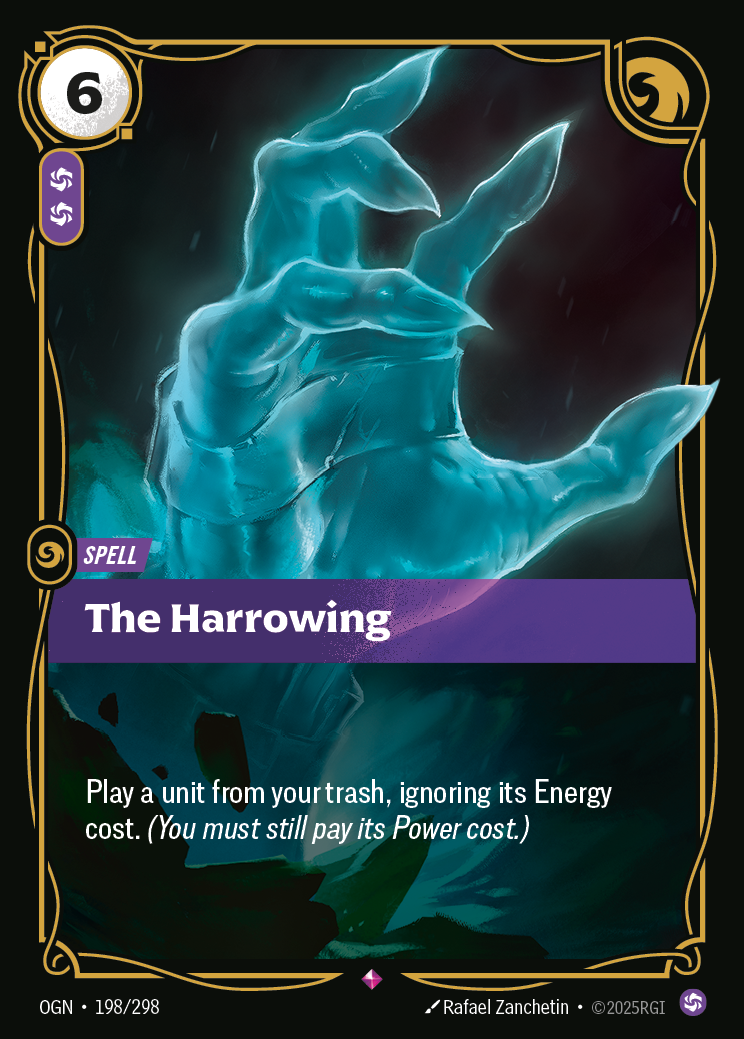
To clarify the timing of these and other effects, we're introducing the idea of pending items on the chain. When you play a spell, or use an ability, they will be pending until you finish the steps of playing them before priority passes. When a spell or ability instructs you to play a card or play a token-or when a triggered ability has its trigger condition met-during the playing or resolution of another card or ability, you'll perform the very first step of playing that card or using that ability by putting it on the chain, then stop. This chain item is still pending for now. You'll then process the rest of whatever is currently happening, including putting any other pending items on the chain above it.
Then, in the order the items were put on the chain, each pending item's controller goes through the other steps of putting it on the chain: Make choices, pay costs, and evaluate legality. Only then is the pending item considered to have entered the chain. If it's legal to play and it's a unit or gear, it resolves immediately as usual. Once all pending items are done being fully added to the chain, play continues, and any items that remain on the chain can be reacted to. The most recent items to be placed on the chain will resolve first as usual.
If at any point during that process that player is unable to proceed with playing the pending chain item for any reason, the item is removed from the chain and, if it's a card, is put back where it came from. This won't happen very often-if you start the process of playing a card, you'll almost always be able to legally finish it-but it's a necessary failsafe to handle corner cases.
Q: What about cards like Blind Fury and Promising Future, which let players look at or reveal cards from the top of a deck, play one, and recycle the rest? If I can't play that card, where does it go? It sounds like it's too late for it to be recycled as part of "the rest."
Hey, you're pretty sharp! For most cards that let you play something, it's easy to put the card back where it came from if you can't play it. The Harrowing would put it back in your trash, Ava Achiever would put it back in your hand, and so on. But when the card came out of a deck, which is both secret and randomized, it's not so simple.
To provide a clear and easy answer to this question, four cards in set 1 that let you play other cards from decks are receiving errata. They'll each banish the card before instructing a player to play it. If the card can't be played for any reason, it just stays banished. This is a small functional change, but it's one we feel is well worth it to avoid the fuss of getting these cards back into a deck somehow.
Baited Hook
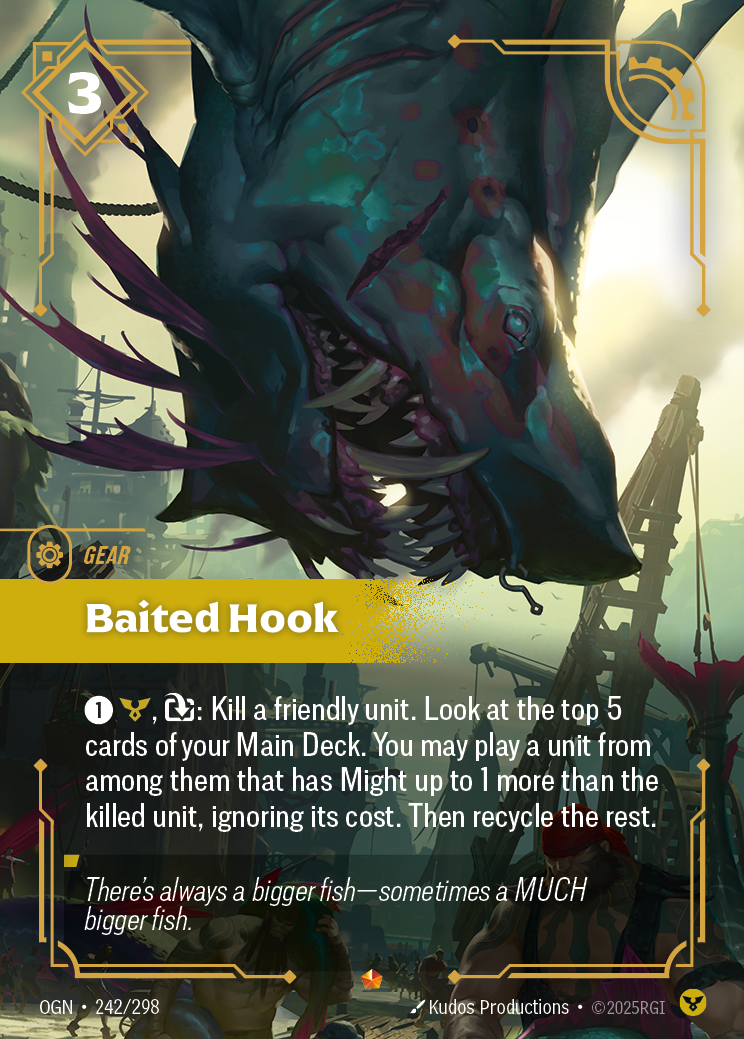
[1][C], [E]: Kill a friendly unit. Look at the top 5 cards of your Main Deck. You may banish a unit from among them that has Might up to 1 more than the killed unit and play it, ignoring its cost. Then recycle the rest.
Blind Fury
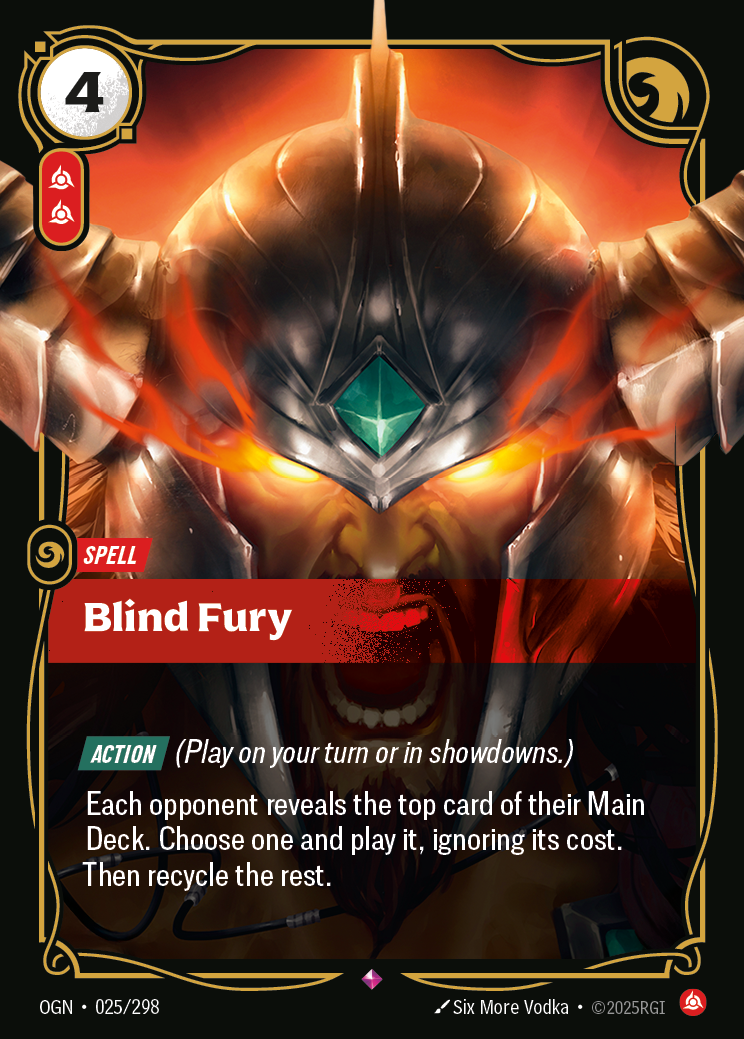
[Action] (Play on your turn or in showdowns.) Each opponent reveals the top card of their Main Deck. Choose one and banish it, then play it, ignoring its cost. Then recycle the rest.
Dazzling Aurora
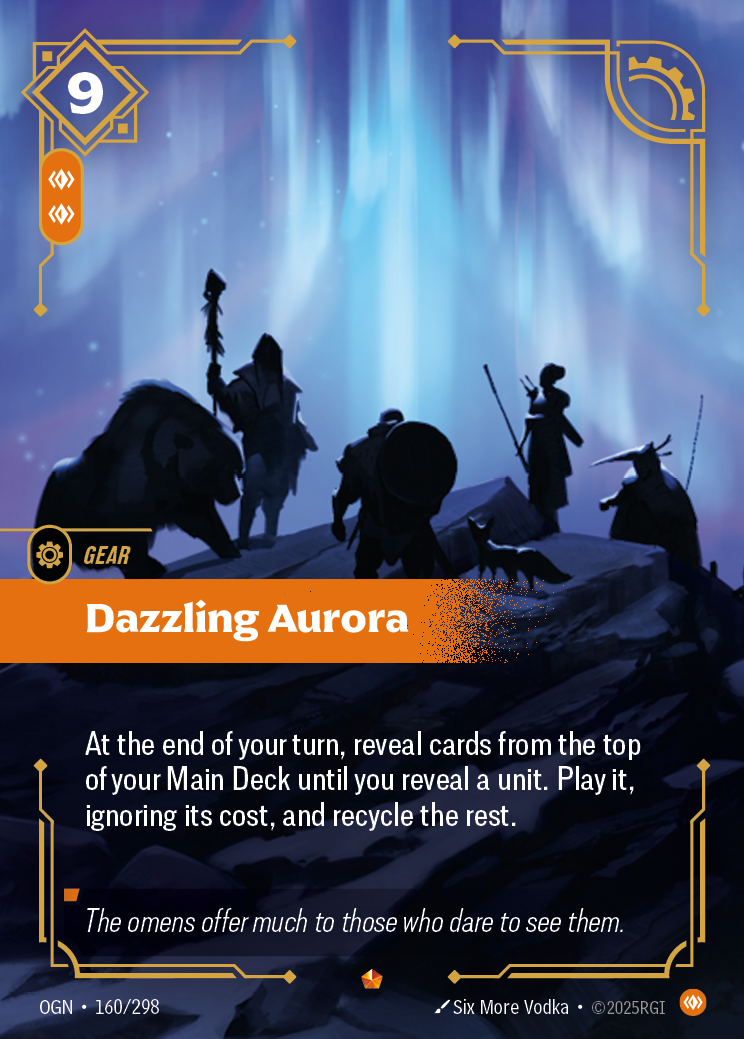
At the end of your turn, reveal cards from the top of your Main Deck until you reveal a unit and banish it. Play it, ignoring its cost, and recycle the rest.
Promising Future
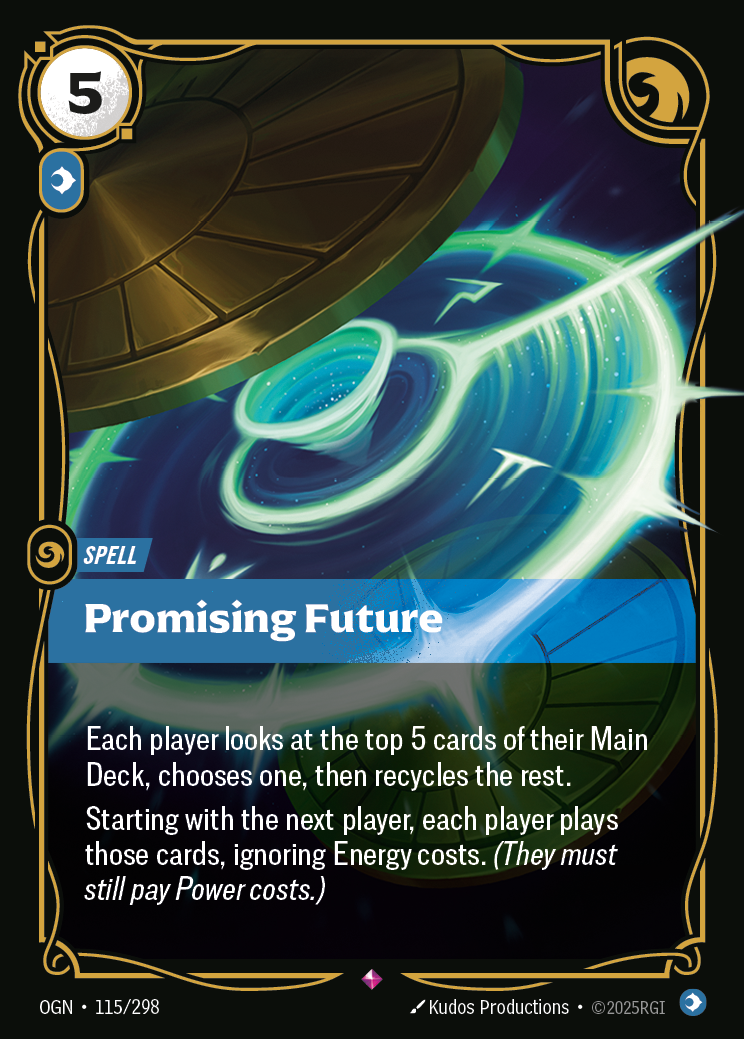
Each player looks at the top 5 cards of their Main Deck, banishes one, then recycles the rest. Starting with the next player, each player plays those cards, ignoring Energy costs. (They must still pay Power costs.)
Q: So what exactly happens when someone plays Promising Future?
Start with the player whose turn it is-probably Promising Future's controller. That player looks at their top 5 cards, banishes one of them, and recycles the other 4. Then each other player in turn order repeats this process. Each player can see which cards the players before them have chosen. Then, starting with the next player in turn order this time, those players put the cards they chose onto the chain as pending items, with the player whose turn it is putting their item on the chain last.
Then Promising Future finishes resolving, and the players finish adding their pending items to the chain in the same order they were put there, ignoring Energy costs but still paying Power costs. They must pay mandatory additional costs (like the cost of Cruel Patron), and may choose to pay optional additional costs (like Accelerate).
Each card that's a unit or gear resolves immediately, which may cause other things (such as play effects) to be added to the top of the chain as pending items. Any cards that can't be played for any reason remain banished.
Once this process is done, any units or gear that were successfully played this way will be on the board, while spells chosen this way will all be on the chain in the same order they were put onto it. (This may result in spells that don't have Action or Reaction being on the chain above other items, which is usually not possible. That's fine.) Then, resolve the chain as normal.
Q: What about Nocturne? Doesn't he also let you play a card from the top of a deck?
Great question! Nocturne is his own thing. Speaking of which...
Nocturne, Horrifying
Q: OK, so what about Nocturne? How does his ability work? Is it a triggered ability? Can I use it if I "reveal" him, or only if I "look at" him?
Nocturne has a few problems we'd like to address.
- His ability is worded like a triggered ability ("when"), but it can't really work like one. By the time a triggered ability could go on the chain, be reacted to, and resolve, you wouldn't be looking at Nocturne anymore.
- He has the same problem that the above cards do: you're trying to play a card from a deck (in this case, Nocturne himself), and it's hard to put him back there if you try to play him but can't for some reason.
- He is intended to be usable any time you're looking at the front faces of cards from the top of your deck, whether the effect in question says to "look at" them or "reveal" them. The rules will be changed to clarify that last one-they will now explain that to "reveal" means the same thing as "allow all players to look at."
Nocturne is receiving errata to solve these problems and bring him in line with his intended function. This errata makes it clear that this ability is not a triggered ability, and it uses banishment as a holding zone. It also specifies that revealing and looking both count; although we are handling that part at the rules level, we also want card text to reflect it unambiguously.
Nocturne, Horrifying
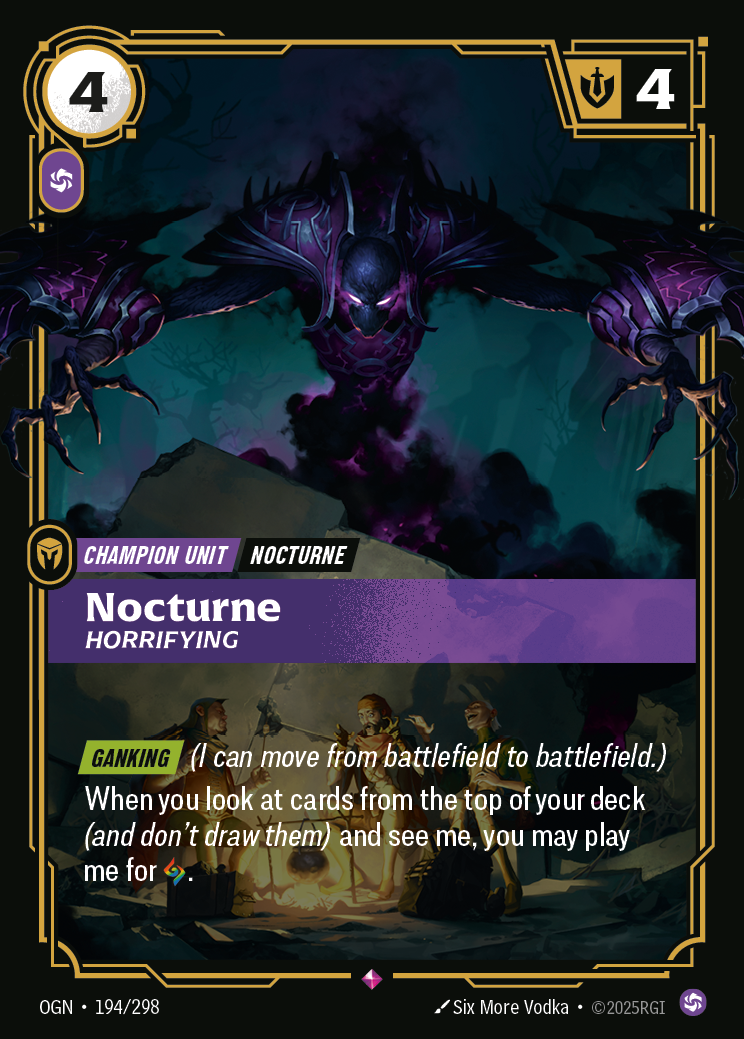
[Ganking] (I can move from battlefield to battlefield.) As you look at or reveal me from the top of your deck, you may banish me. If you do, you may play me for [A].
Q: So how exactly does this ability work?
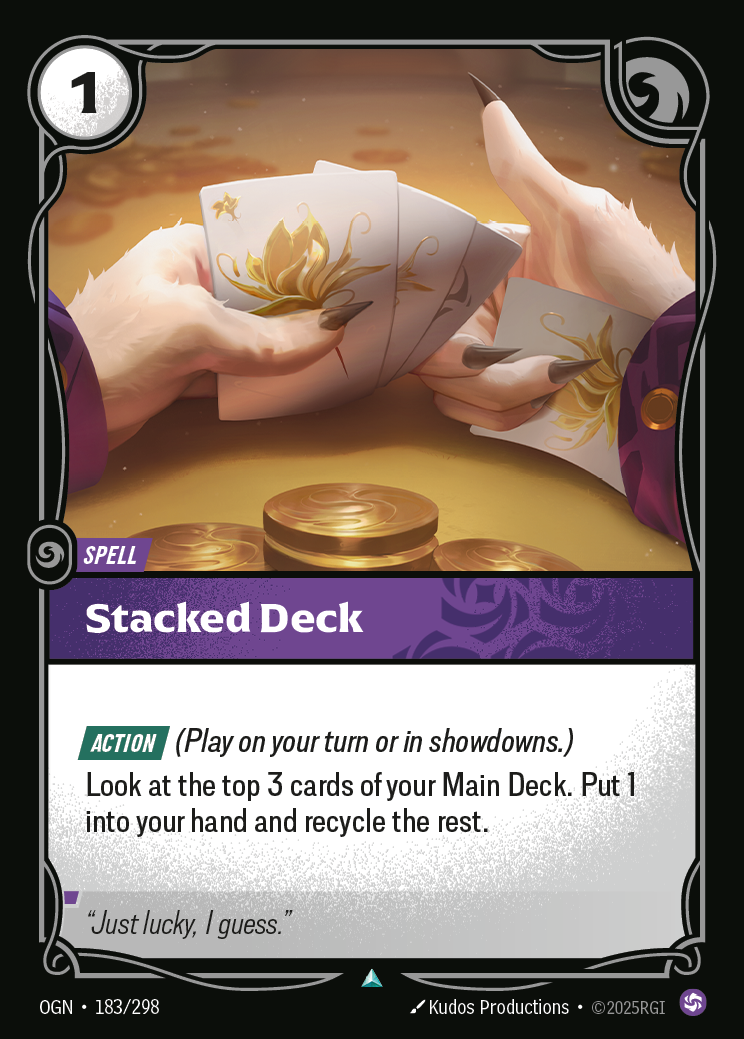
The process starts as you look at or reveal cards from the top of your Main Deck due to an effect. Let's use Stacked Deck as an example. You play Stacked Deck and look at the top 3 cards of your deck. Nocturne is among them. You now get to choose whether to banish him or not. If you choose to banish him, you immediately begin the process of playing him from banishment, placing him on the chain as a pending item. Then you continue resolving Stacked Deck. There are only 2 cards left of the original 3; you'll choose one to put into your hand and recycle the other one. Then, since Stacked Deck has finished resolving, you'll finish the steps of putting Nocturne onto the chain from banishment, paying [A] (that's one power of any type) instead of his base cost. As usual for units, he'll resolve immediately and enter the board exhausted. If you weren't able to play him for any reason, he'll just stay banished.
Q: If I reveal multiple Nocturnes, can I play more than one? What if all 3 of the cards I look at for Stacked Deck are Nocturnes and I play all of them?
Yes, you can play more than one Nocturne at a time this way. If there aren't any eligible cards left for the original effect you were resolving, any further instructions will be ignored. So if you reveal Stacked Deck, see 3 Nocturnes, and opt to banish and play all of them, you won't put any cards into your hand, nor will you recycle any cards. You will, however, have 3 Nocturnes.
Q: So if Promising Future resolves and one or more players choose to banish Nocturne from the cards they looked at, what happens?
As you go around in turn order and each player looks at their top 5, they can choose to banish one or more Nocturnes before they banish a card with Promising Future. Any such Nocturnes will go on the chain as pending items before whatever that player chooses with Promising Future. They'll remain pending through the whole process of resolving Promising Future, then at the appropriate point they'll be fully placed on the chain and (because they're units) will resolve immediately.
Q: What about Dazzling Aurora? If I reveal Nocturne, do I get to play him and keep going?
No, Dazzling Aurora stops when it finds Nocturne. Nocturne is revealed, then you may choose to banish him or not. If you banish him, you can play him for [A] using his own ability. If you don't, you can play him for free using Dazzling Aurora's ability (probably better, but you do you). Either way, you revealed a unit, so you don't keep going.
Baited Hook
Q: What happens if I use an effect like Unlicensed Armory to prevent the death of the friendly unit I chose to kill with Baited Hook?
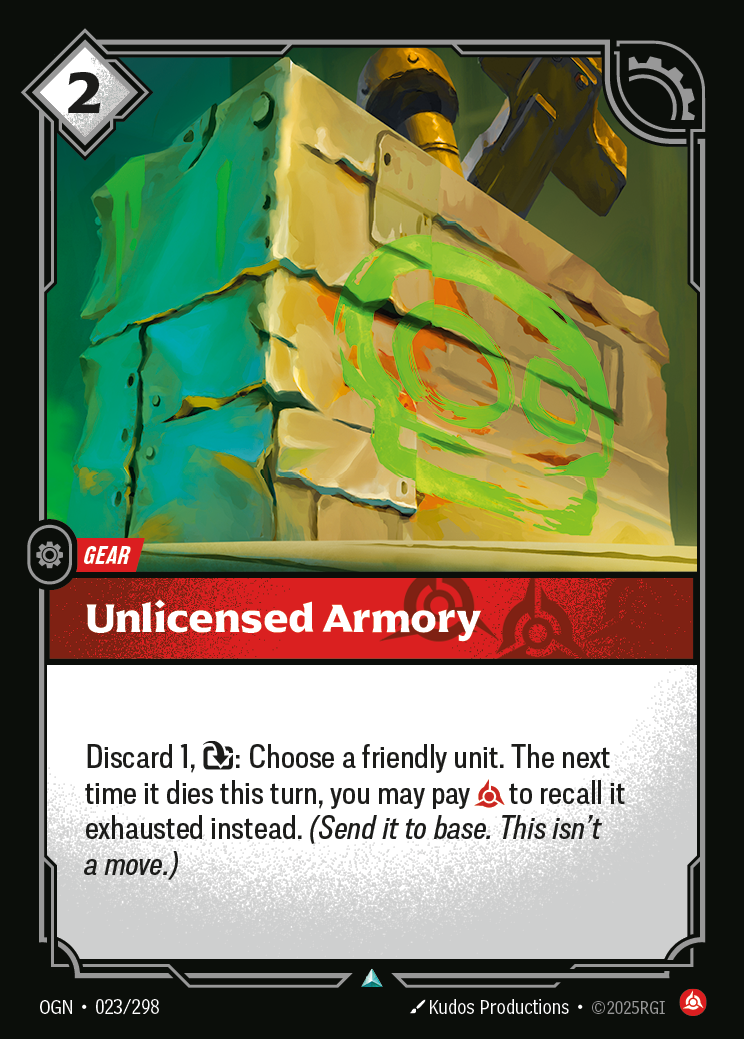
Baited Hook kills a unit, then uses information about "the killed unit." If you prevent that unit's death, there's no killed unit, so Baited Hook can't evaluate its Might. As a result, the check for the Might of the "killed unit" returns a null value, and you're not able to play any unit. If the unit is killed before the ability of Baited Hook resolves, the outcome is the same.
Convergent Mutation
Q: The English version of this card is missing "this turn," but the Chinese version includes it. Which is correct?
The English version is a printing error. Convergent Mutation will receive errata to correct this oversight. Meanwhile, the Chinese version uses "becomes" language where the English version uses "increase." We have opted to keep the "increase" wording from English, as these wordings work slightly differently
Convergent Mutation
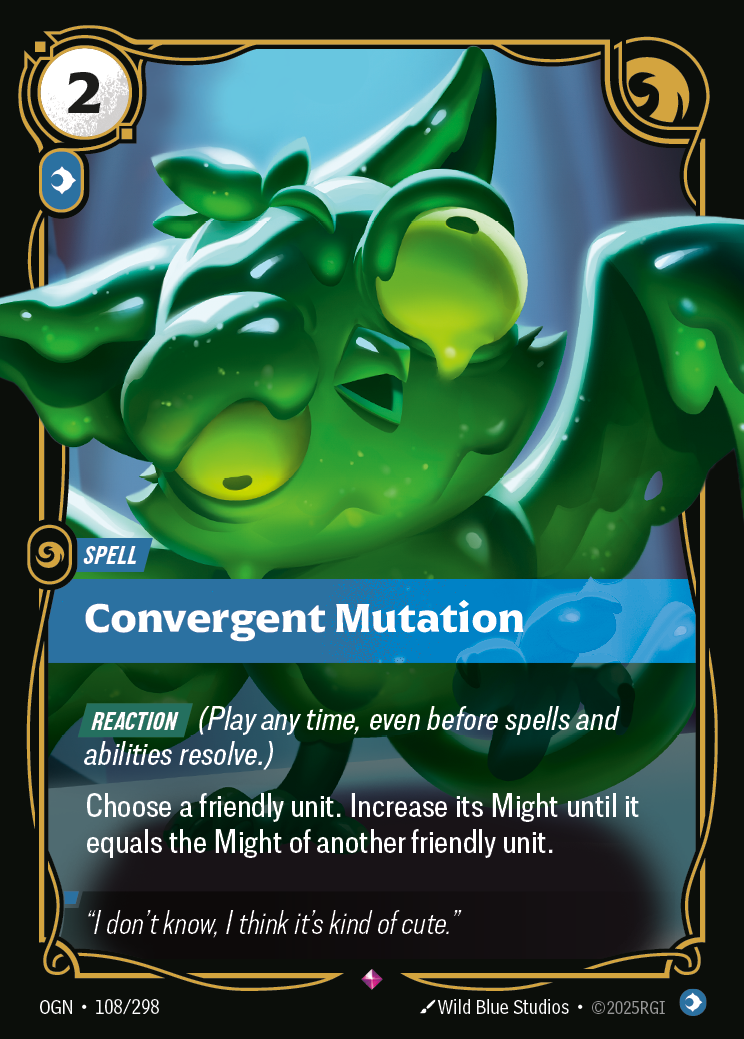
[Reaction] (Play any time, even before spells and abilities
resolve.)
Choose a friendly unit. This turn, increase its Might to the
Might of another friendly unit.
Dune Drake
Q: What about Dune Drake? It's missing "this turn" in both English and Chinese.
This is also a printing error, one that wasn't caught in time to fix the Chinese version. It will also receive errata.
Dune Drake
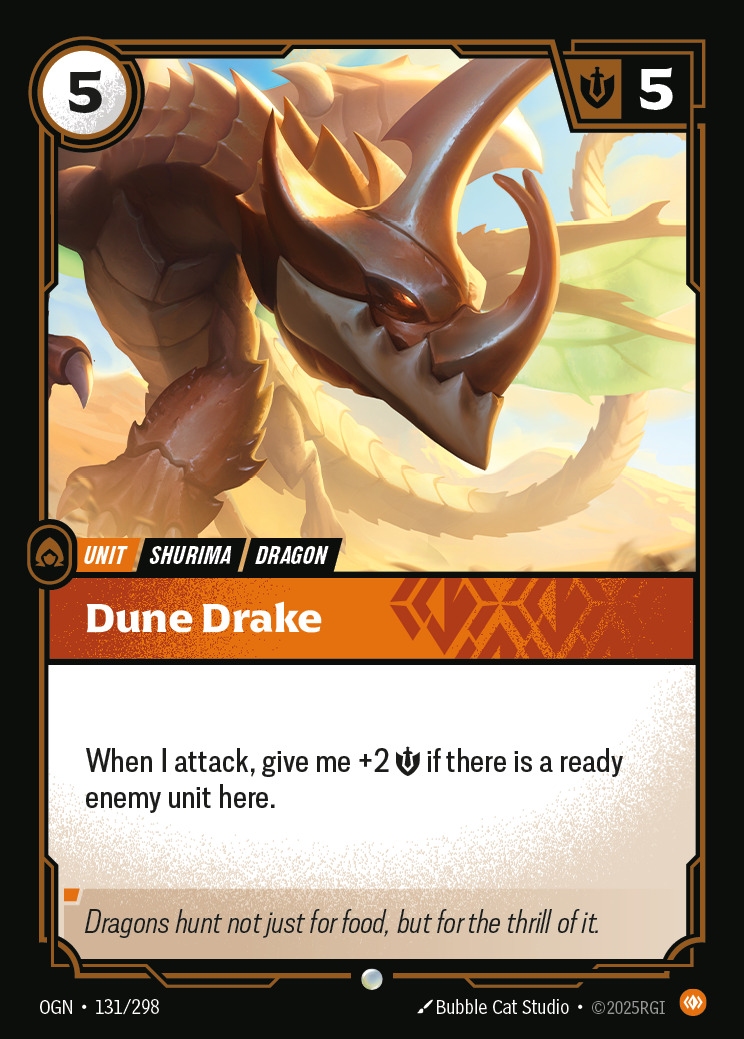
When I attack, give me +2 [M] this turn if there is a ready
enemy unit here.
Ravenborn Tome
Q: Is Ravenborn Tome supposed to be able to grant bonus damage to spells I play on later turns?
No. This is another card that's missing "this turn."
Ravenborn Tome
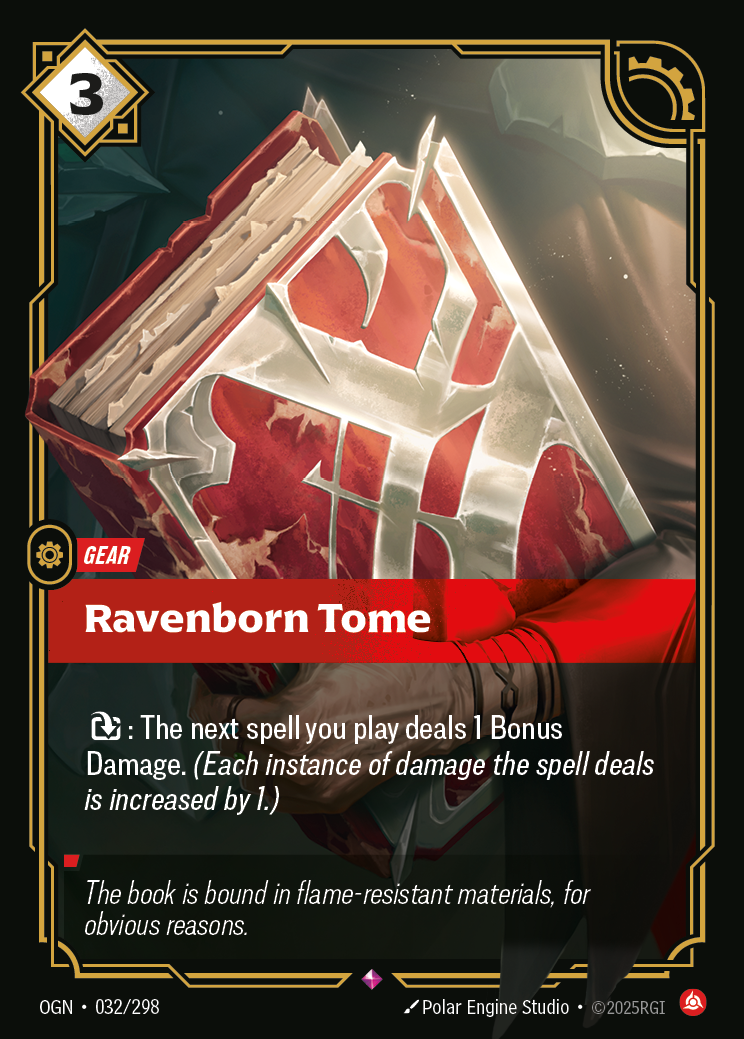
[E]: The next spell you play this turn deals 1 Bonus Damage.
(Each instance of damage the spell deals is increased by
1.)
Making Choices for Spells and Abilities (Targeting)
Q: Some spells and abilities require choosing units, gear, or other things for them to affect. The rules say some of these choices are made when I put the spell or ability on the chain, but it seems like some of them can't be or shouldn't be. How do I know the difference?
Riftbound uses a set of contextual rules rather than specific words on cards to determine which choices are made as a card is played. When a spell or ability chooses something else to affect, the rules refer to those choices as "targets." Targets must be chosen as the spell or ability is placed on the chain, and they must still meet all targeting requirements as the spell or ability resolves.
The next version of the rules will have more rigorous guidelines on which choices are targets, which we'll summarize here. For the most part, these rules don't change what choices are targets, they just spell it out more.
An object or player mentioned in a spell or ability is a target if all of the following are true:
- something publicly visible to all players;
- that you and you alone choose;
- that isn't part of a targeting restriction, cost, trigger condition, replacement effect, or an action that "must" be taken.
This explanation sounds complicated, but in general, most things that are affected by a spell or ability are targets. For a more precise breakdown of what each of those entails, see the Appendix.
There are two other choices that are not considered targets, but are made while putting something on the chain. Those are:
- The location to which a unit will be played (normally either your base or a battlefield you control).
- The destination or destinations for any spell or ability whose effect is moving one or more units, whether or not it mentions a destination by name.
Charm
Q: So as I play Charm, I have to say not only what unit I'm moving it, but where I'm moving it to?
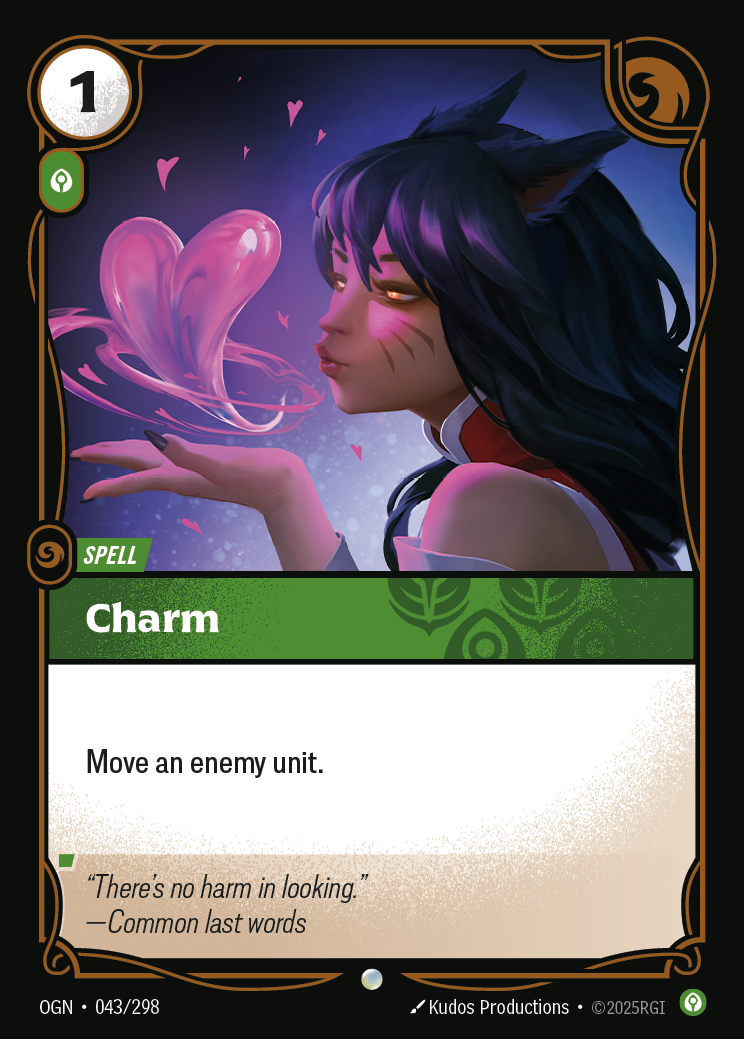
Yes. This is a change from prior rulings. This means that move effects that don't mention a destination (like Charm) work the same way as those that do (like Showstopper).
Q: What about when I use a unit's standard move? Does that target?
No. The standard move is a special action that doesn't use the chain and can't be reacted to, so the concept of targeting doesn't apply. You announce which units are moving and what destination they're moving to, then move those units there immediately.
Spells with Multiple Targets
Q: If a spell has multiple targets, like Back to Back, do I need to choose targets for all of them to put the spell on the chain?
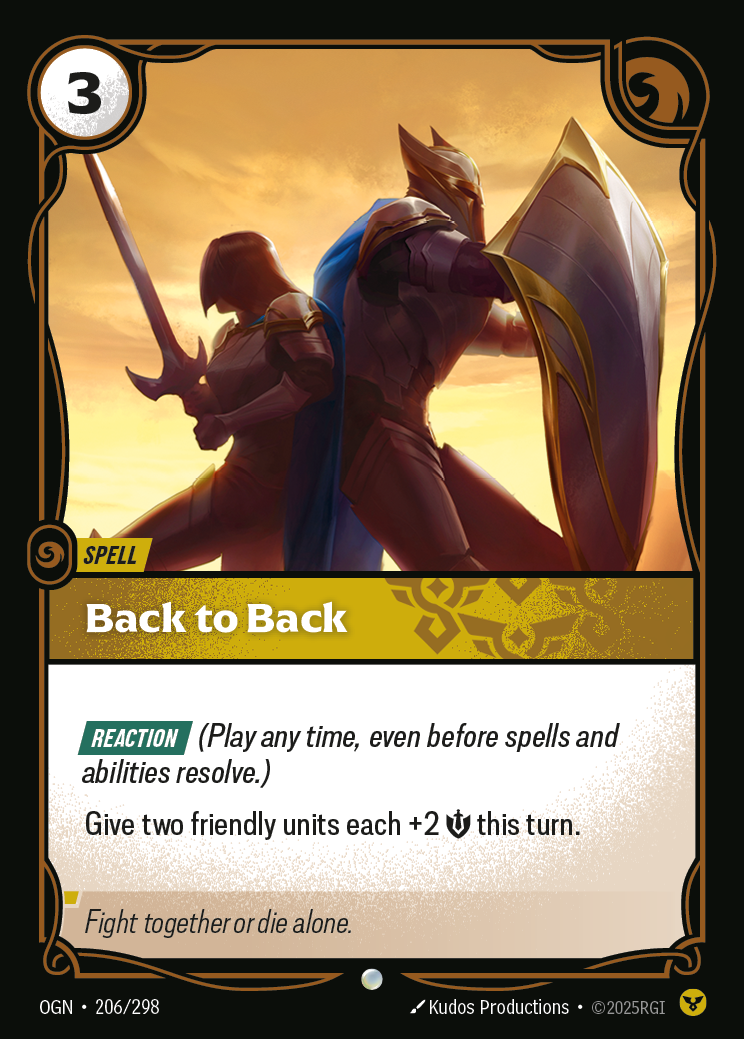
Yes. You must choose two different friendly units to play Back to Back, although it still resolves even if one or both of its targets are no longer valid when it resolves.
This is also true for activated abilities that have multiple targets.
Abilities with Multiple Targets
Q: What about triggered abilities with multiple targets, like Sona, Harmonious?
The same is true of triggered abilities with multiple targets. For triggered abilities, however, this causes some cards-Sona in particular-to work in unintended ways.
Going forward, we'll put the words "up to" on most triggered abilities. In the meantime, several cards are receiving errata so that their triggered abilities behave intuitively.
Sona, Harmonious
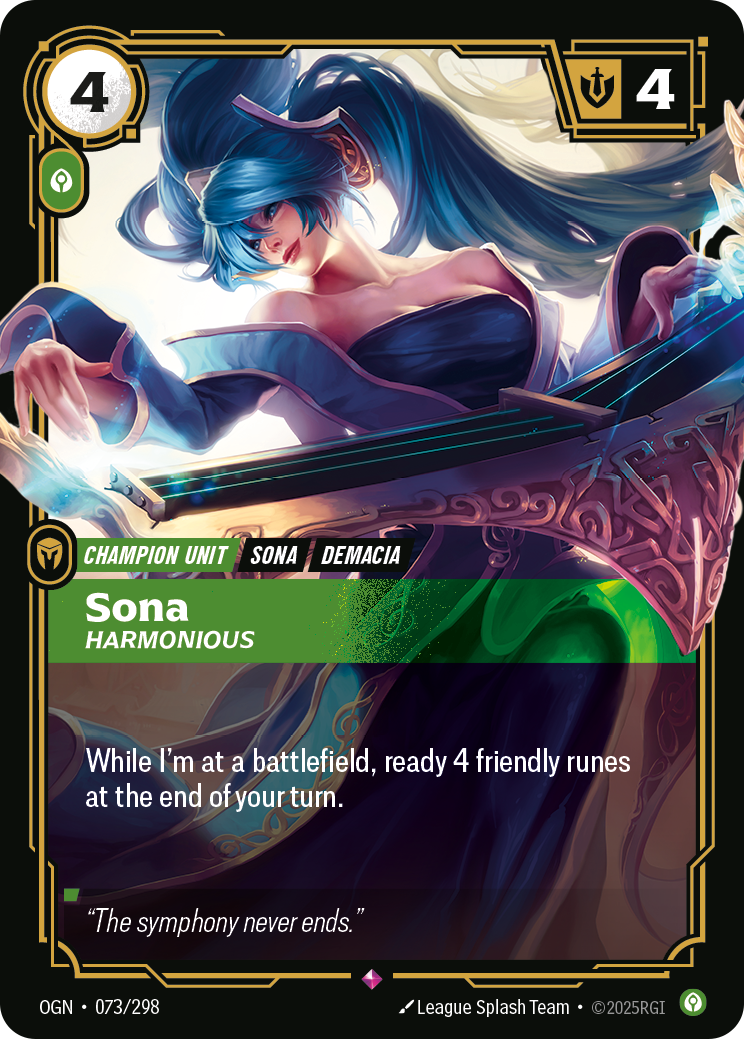
At the end of your turn, if I'm at a battlefield, ready up to 4 friendly runes.
Targon's Peak
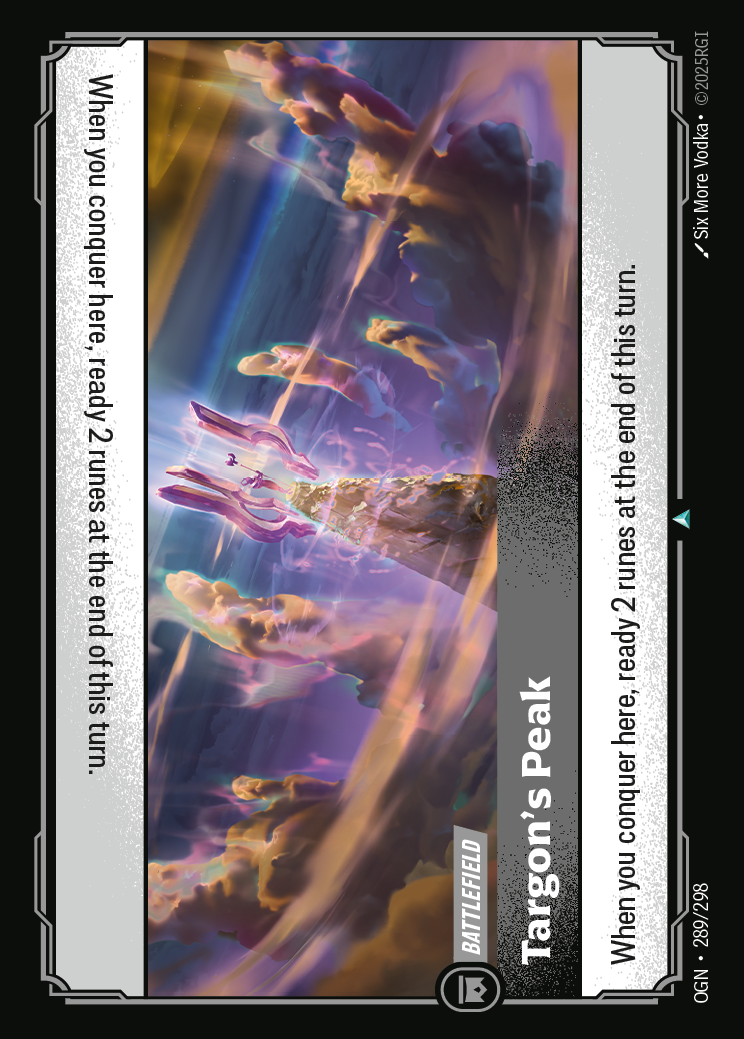
When you conquer here, ready up to 2 runes at the end of this turn.
Dark Child - Starter
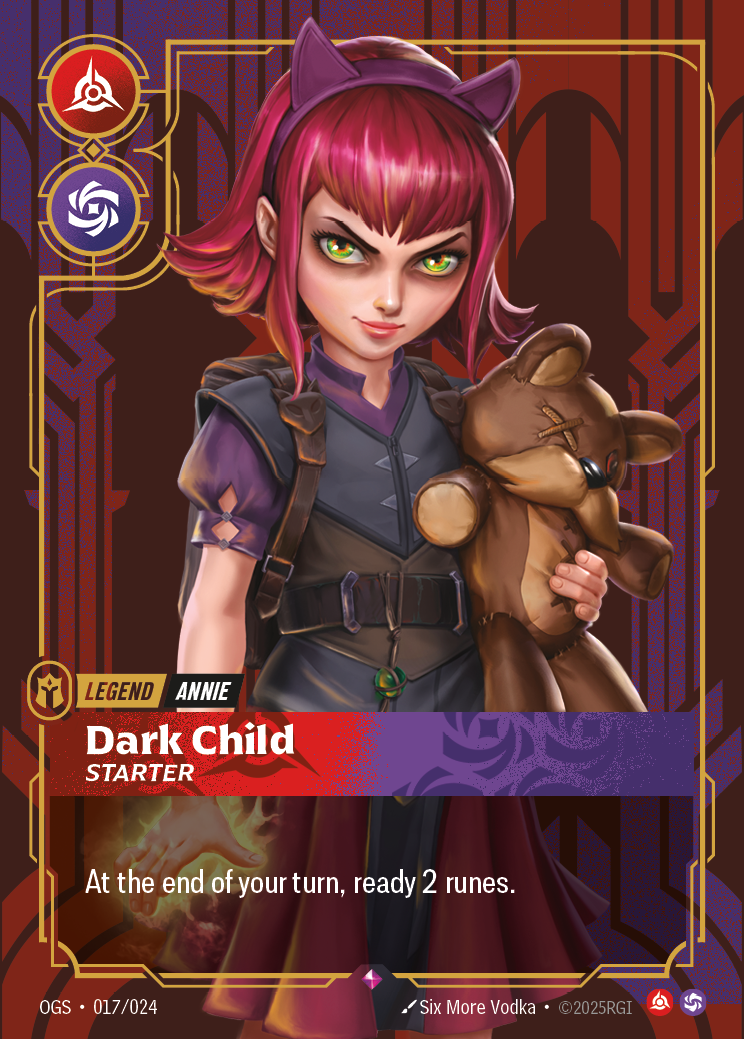
At the end of your turn, ready up to 2 runes.
Kinkou Monk
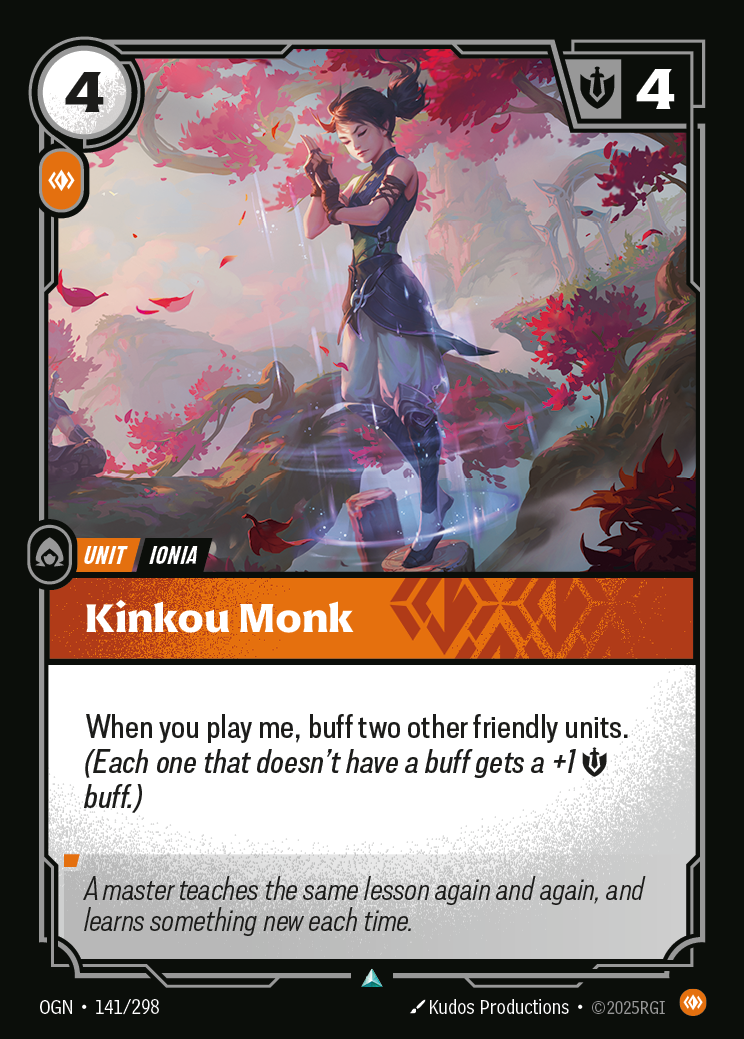
When you play me, buff up to two other friendly units.
(Each one that doesn't have a buff gets a +1 [M] buff.)
Sigil of the Storm
Q: Does Sigil of the Storm target? If it does, can I react to the trigger by recycling the chosen rune for Power? That seems weird.
Sigil of the Storm is receiving errata using a new wording to make sure that it doesnʼt target. This uses a new wording, "must," that indicates an action that must be taken. None of the choices made for such an ability are targets, and they are chosen as the ability resolves.
Sigil of the Storm (revised text)
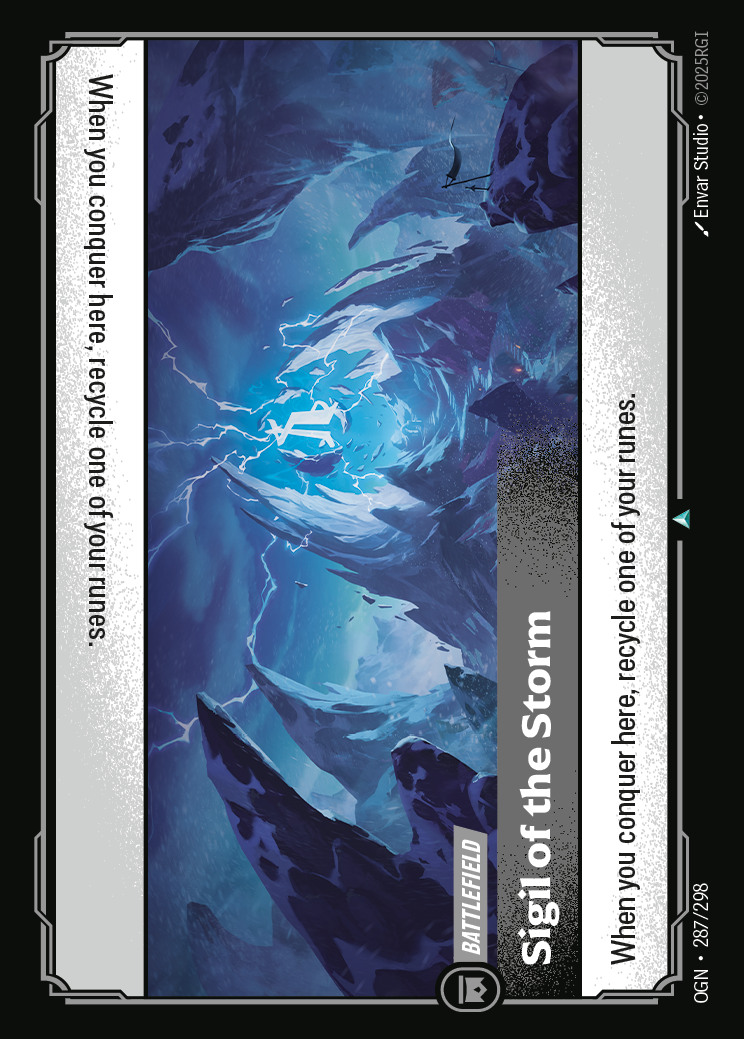
When you conquer here, you must recycle one of your runes.
Fox-Fire
Q: Are the units I choose for Fox-Fire targets? What happens if some of them gain Might as a reaction?
Fox-Fire is unusual (currently unique) in that its targets' legality is evaluated as a group rather than individually. The updated rules will explain how to handle this.
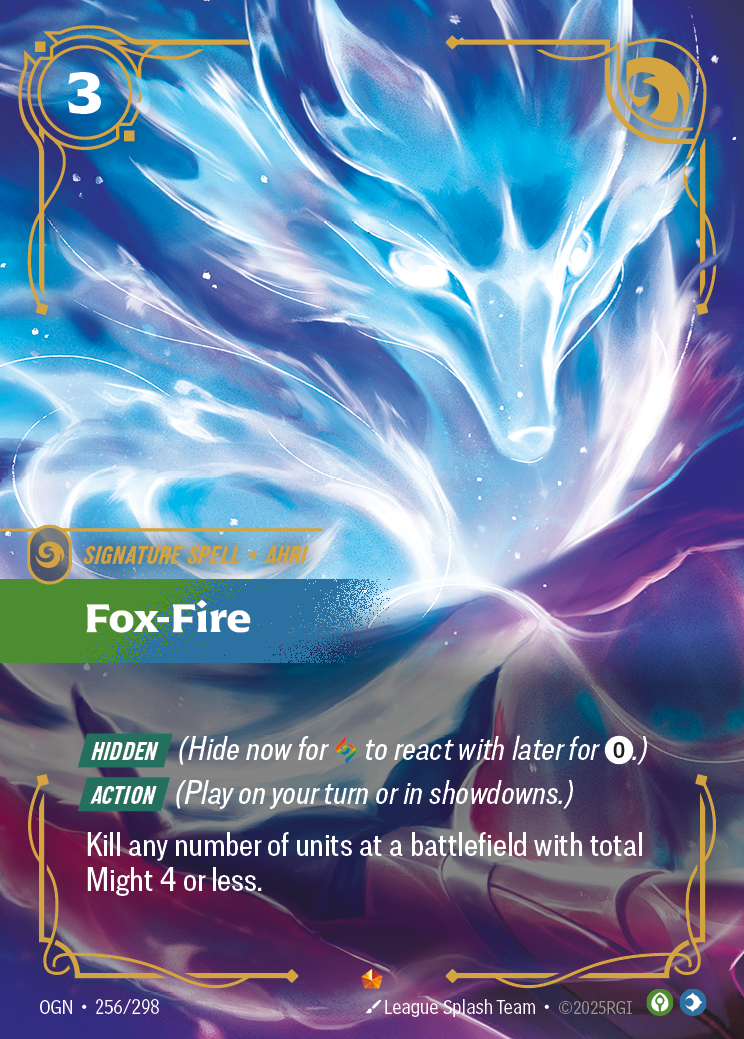
As you play Fox-Fire, you'll choose any number of units at a single battlefield whose current total Might is 4 or less. Then, after any appropriate Reactions, Fox-Fire resolves and checks target legality again. If the units no longer meet the group targeting restriction because some of them have gained Might, you choose any number of the original targets whose Might adds up to no more than 4.
Here are a few examples to illustrate. In all of them, Fox-Fire initially chooses 4 Recruits with 1 Might each, and some of those Recruits have gained Might before Fox-Fire resolves.
- One Recruit gets +1 Might. You can choose either to exclude that Recruit and kill the other three (total Might 3), or exclude one other Recruit and kill the 2 Might Recruit and two 1 Might Recruits (total Might 4).
- One Recruit gets +3 Might. You can choose either to exclude that Recruit and kill the other three (total Might 3), or exclude the other three and kill just that one (total Might 4).
- One Recruit gets +6 Might. You must choose to exclude that Recruit, because its Might alone takes you above your total. You must kill the other three (total Might 3).
- Two Recruits get +1 Might. You can either kill the two 2 Might Recruits, or one 2 Might Recruit and the two 1 Might Recruits.
- All four Recruits get +1 Might. You must choose two of the Recruits to kill, and the other two will survive.
- All four Recruits get +3 Might. You choose one Recruit to kill (total Might 4) and exclude the rest.
- All four Recruits get +6 Might. You no longer have a valid subset of targets, because even a single Recruit takes you over the Might limit. Fox-Fire does nothing.
Q: Does that mean if the units I originally chose die, move, or lose Might as a Reaction, I can pick additional units at that battlefield to kill?
No. You can only kill units from among the ones you initially chose.
Dragon's Rage
Q: Dragon's Rage also seems a little confusing under these targeting rules. What do I have to choose as I play it?
Dragon's Rage works a little better now that move destinations are chosen at the same time as targets, but it's still kind of strange. Accordingly, it will receive errata with a new template for "reflexive triggers"-triggered abilities within another spell or ability that create a new ability that goes on the chain separately from the original spell or ability. To show you what that looks like, here's the updated text:
Dragon's Rage
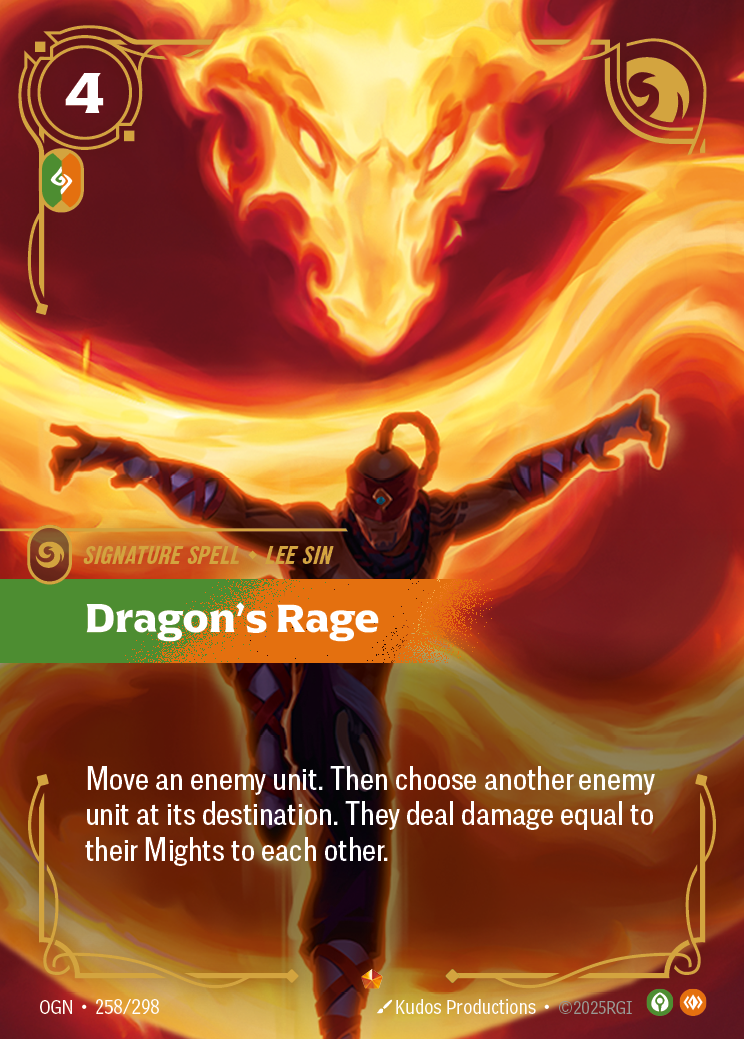
Move an enemy unit. Then do this: Choose another enemy unit at its destination. They deal damage equal to their Mights to each other
That "do this" wording (or similar) tells you that what follows is a separate instruction from the original. As you start to play Dragon's Rage, you only need to choose an enemy unit and a battlefield to move it to. Then, assuming Dragon's Rage resolves, you'll put a separate triggered ability on the chain, choosing another enemy unit at its destination (if one is available). That triggered ability can then be responded to separately. If there's no enemy there, or if you didn't actually move the unit you chose for any reason (and therefore there's no "its destination" to reference), the trigger isn't put on the chain at all.
This isn't a tool we expect to use often, but it lets us make sure that cards like Dragon's Rage offer chances for interaction and decision at points that feel appropriate.
Disintegrate
Q: How does Disintegrate work? Doesn't the damage kill the unit after the spell has resolved?
Disintegrate is a funny one-it looks like it works, but the more you understand the rules, the more it looks like it might not work after all. Units dealt lethal damage by a spell aren't killed immediately, they're killed right after that spell resolves. To solve this little rules conundrum, we're using the new reflexive trigger wording here as well.
Disintegrate
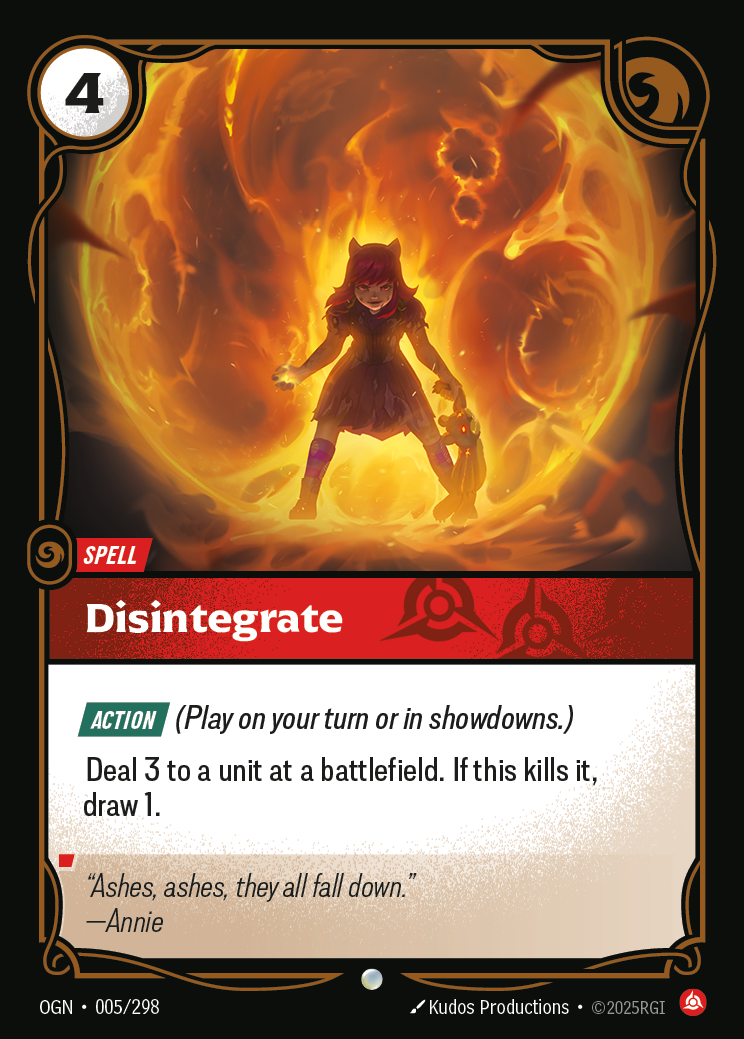
Action (Play on your turn or in showdowns.)
Deal 3 to a unit at a battlefield. If this kills it, do this: draw 1.
Falling Star & Icathian Rain
Q: That "do this" wording is a lot like the one on Falling Star and Icathian Rain. Are those reflexive triggers too?
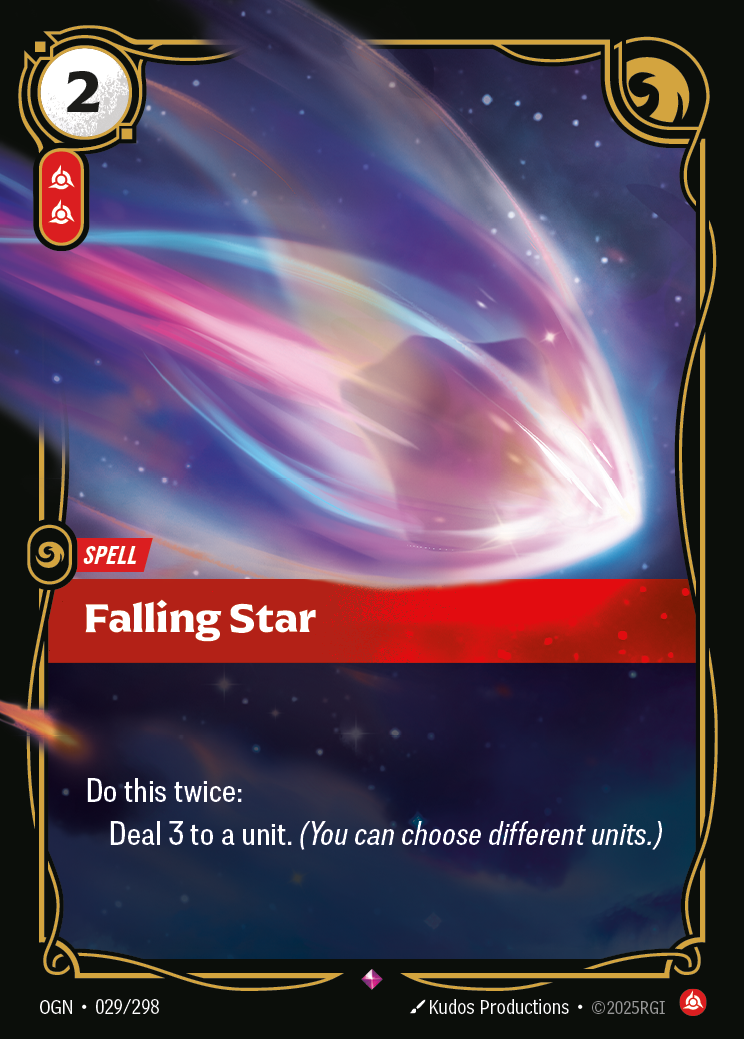
Yes! This means that these two spells no longer actually have any targets of their own-you play them with no choices. If they resolve, you then put each instance of their reflexive trigger on the chain separately, choosing the same or different units as you like. You'll pay Deflect costs for each one as you put each trigger on the chain, and then the triggered abilities will resolve one at a time in the opposite order they were put on the chain. This is a big change to how those two cards work, but we think it actually matches how many people expected them to work when they first saw them.
Twisted Fate
Q: Twisted Fate too?
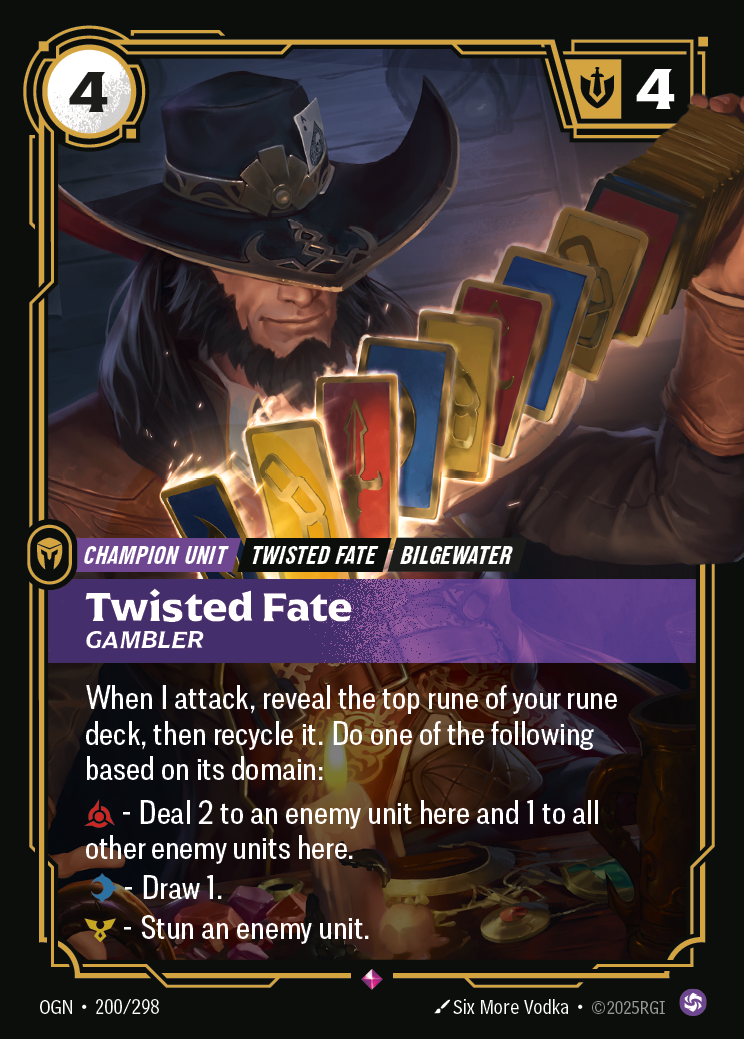
Yes, Twisted Fate's "do one of the following" is also a reflexive trigger.
2v2 and Friendly Units
Q: In 2v2, can my ally and I bring the same legend? What about the same battlefields?
No and no. The updated rules will clarify that you and your ally must bring different legends and different battlefields.
Q: When a card refers to a friendly unit, what does that mean?
In most games of Riftbound, "friendly [something]" means the same thing as "[something] you control." In our 2v2 team format, however, "friendly" includes both things you control and things your ally controls.
Q: What about "your units?" Is that shared between teammates too?
No. "Your" refers exclusively to things you control (on the board or on the chain) or things you own (everywhere else). Your units are the units you control, your spells are the spells you play, your trash is the one where you put the cards you own, and so on.
Q: Can my ally and I share control of battlefields?
No, you and your ally can never have units at the same battlefield. A maximum of two players can have units at a battlefield. Those players must be opponents, and a combat will result.
Q: Can I move my ally's unit to my own base with Unforgiven, the Yasuo legend? Does that mean it's mine now?
No, you can't do this. Any time you try to move something you don't control into your base, it moves to its controller's base instead. This is hard-coded in the rules, similar to how cards you own can ever be in your own hand, trash, or deck, even if something tries to put them in a different when. Similarly, you and your ally can never both have units at the same battlefield; the rules prevent any move that tries to make that happen.
A few cards, including Unforgiven, were printed with English text that suggests misleading outcomes in these situations (but were printed correctly in Chinese). Those cards are receiving errata to clarify what they can and can't do.
The Syren
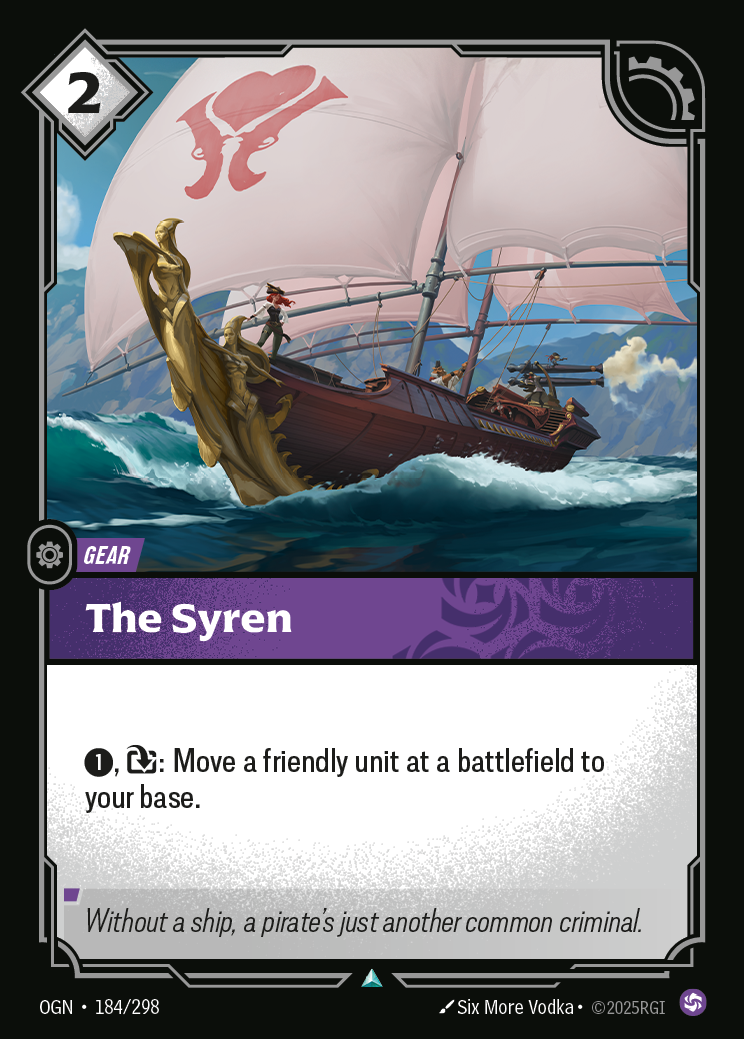
[1], [E]: Move a friendly unit at a battlefield to its base.
Unforgiven
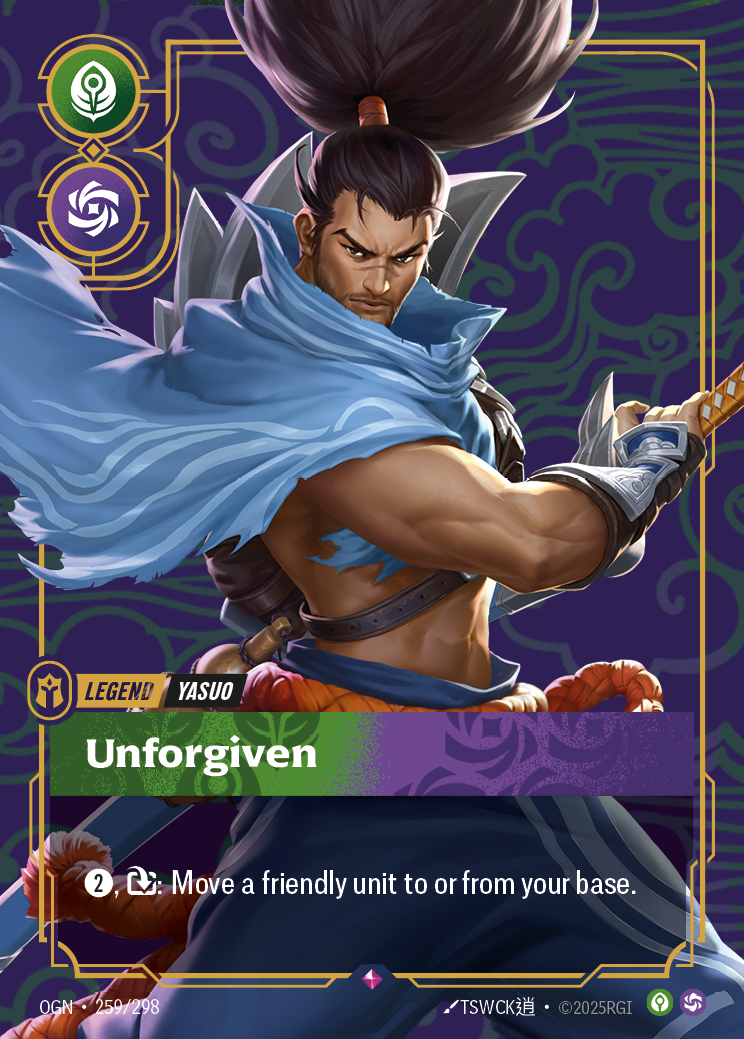
[2], [E]: Move a friendly unit to or from its base.
Portal Rescue
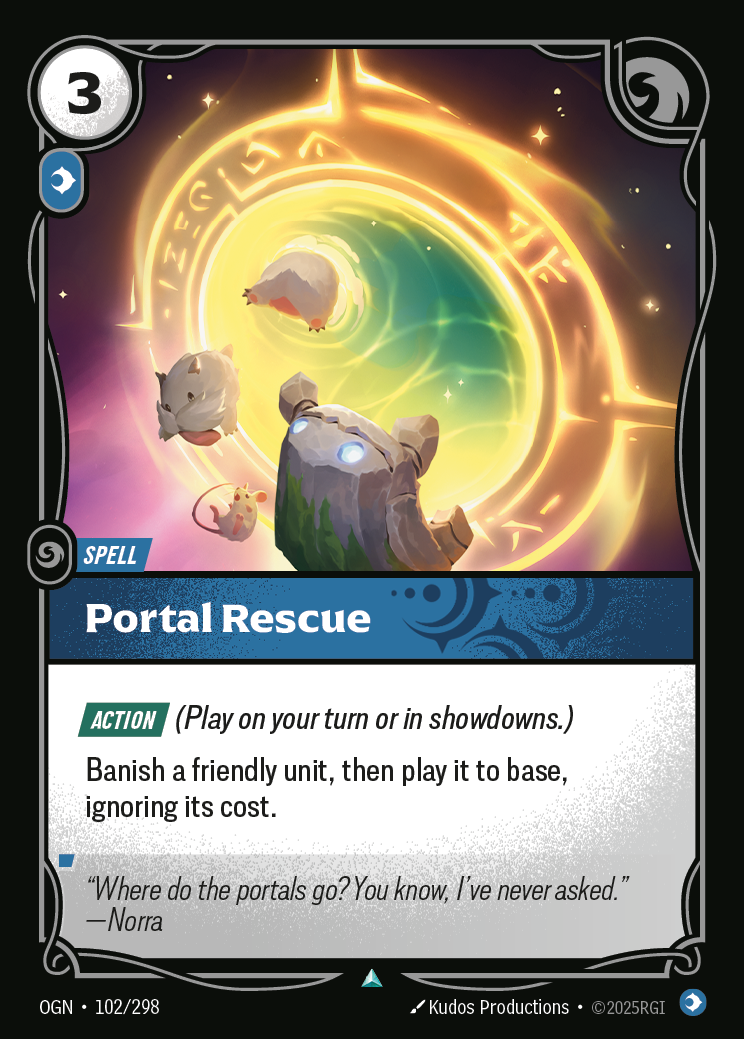
Banish a friendly unit, then its owner plays it to their base, ignoring its cost.
For The Syren and Unforgiven, this is not functional errata, just a clarification. For Portal Rescue, this is a slight functional change to its interaction with cards like Possession. Previously, you could use Portal Rescue to re-play a card you took with Possession and retain control of it, but under the new wording this would give it back to its owner.
Another card, Tideturner, is receiving similar errata and another clarification (see below).
Cards with Hidden
Q: When you play a card from hidden, it gains several additional restrictions. The rules were somewhat unclear on this.
That's not a question. But alright, let's spell out the restrictions more clearly:
- A hidden unit must be played to that battlefield if able.
- If a hidden spell or a play effect of a hidden permanent chooses any targets, those targets must be chosen from among options at that battlefield, unless the ability explicitly restricts targeting in a way that makes this impossible. If a hidden spell or a play effect of a hidden permanent causes you to play a unit, you must choose to have that unit enter the board at that battlefield.
Tideturner
Q: What do the Hidden changes mean for Tideturner? It seems like I'm supposed to be able to choose a unit at another location.
Tideturner is receiving minor errata, both to restrict its targeting to a unit you control and to make sure that it can target a unit at another location under these rules.
Tideturner
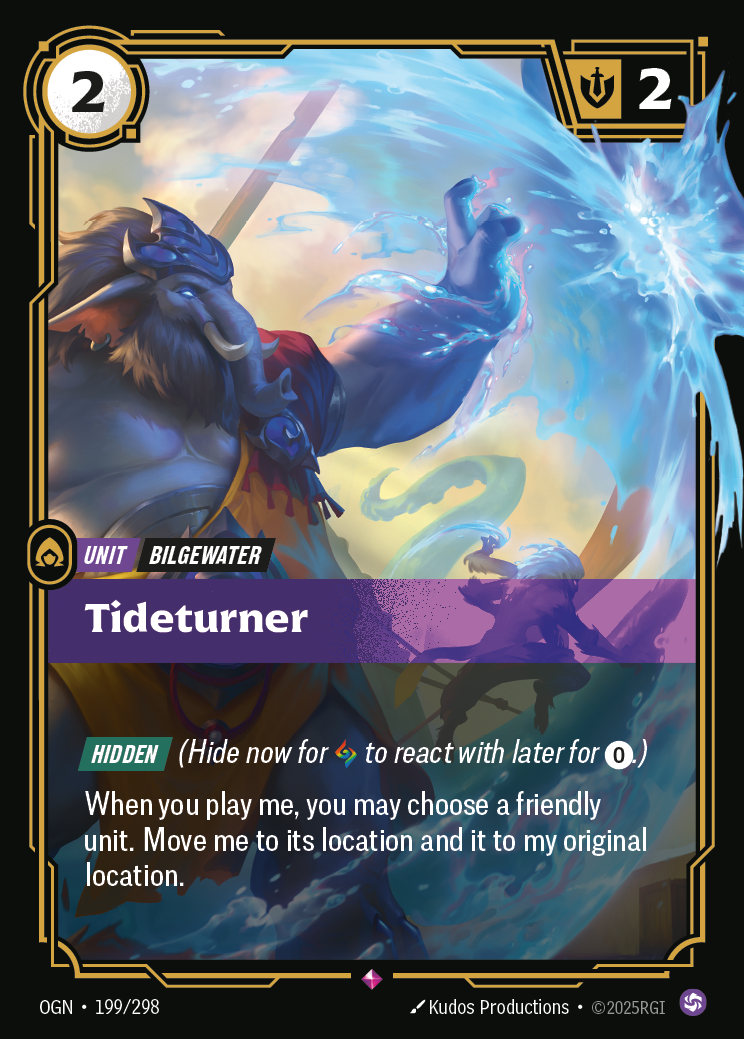
[Hidden] (Hide now for [A] to react with later for [0].)
When you play me, you may choose a unit you control at another location. Move me to its location and it to my original location.
Zhonya's Hourglass & Stand United
Q: What about Zhonya's Hourglass and Stand United? When they're played from hidden, are their effects restricted to the battlefield where they were played?
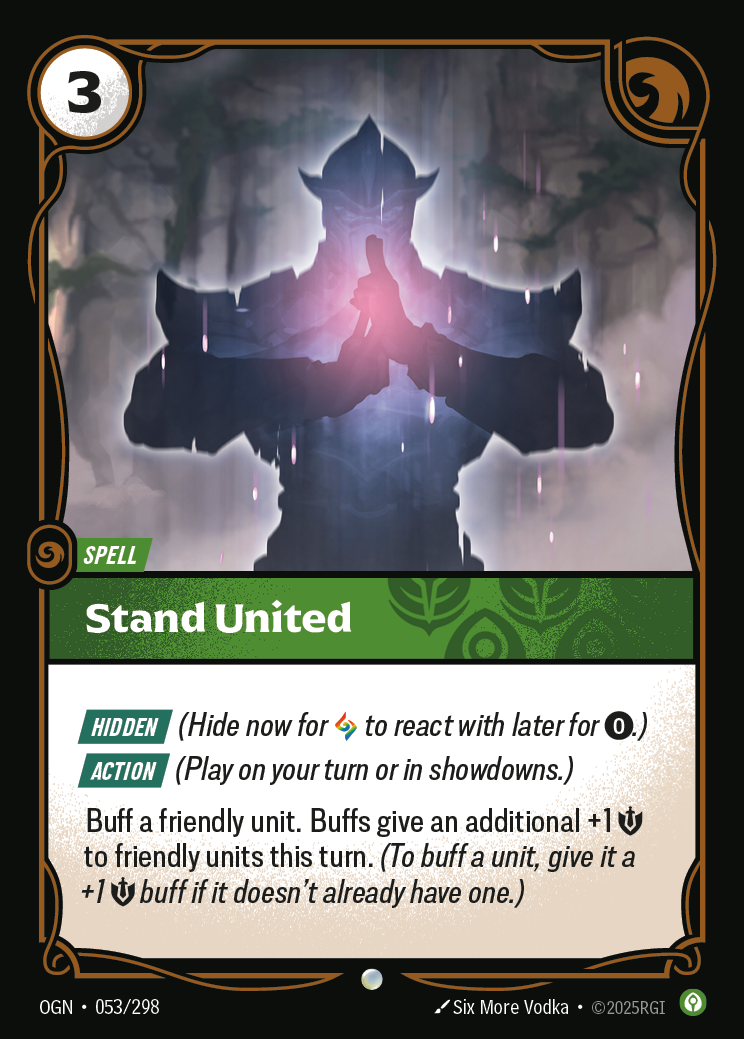
Only effects that choose are restricted. Zhonya's Hourglass saves the next friendly unit that dies anywhere. Stand United can only give a buff to a unit at the battlefield where it was hidden, but its other effect, which causes buffs to grant an additional bonus, applies everywhere. This is a change from previous rulings on these cards, intended to simplify the question of what hidden cards can and can't do.
Zhonya's Hourglass has additional rulings and minor errata related to saving dying units; see below.
Ava Achiever
Q: Does Ava's ability let me hide cards?
No, it lets you play cards with Hidden from your hand.
Q: What restrictions does Ava place on the card I play? What does "here" mean?
Ava's restriction of "here" is meant to apply only to units. She will receive minor errata to make this clearer:
Ava Achiever
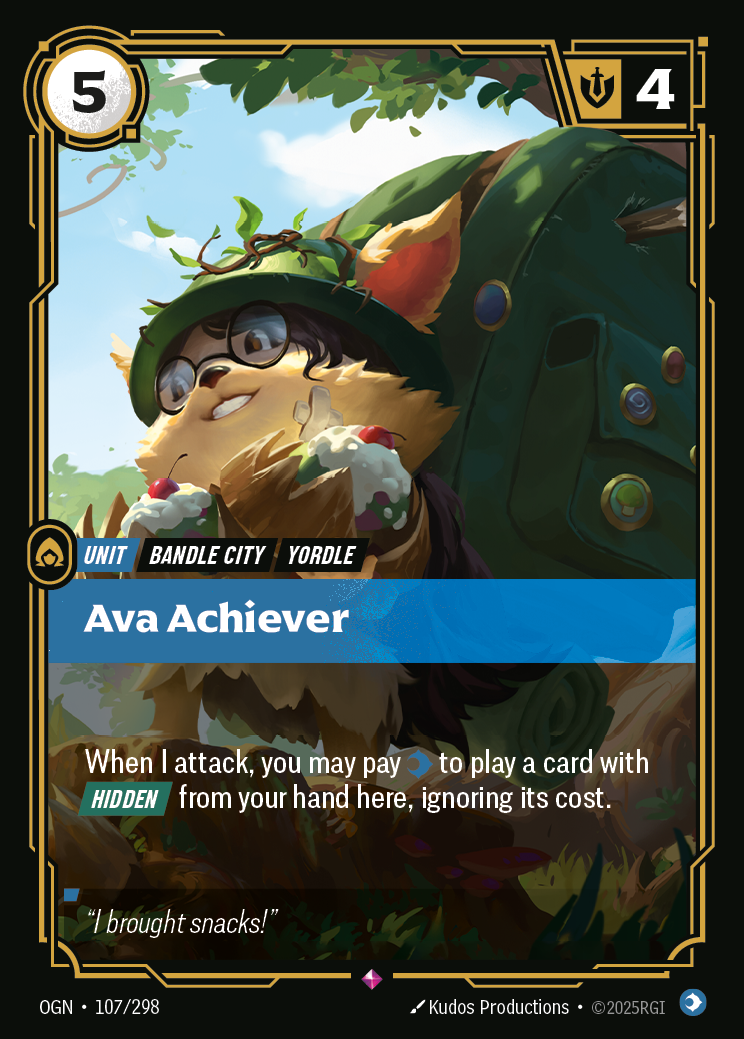
When I attack, you may pay [C] to play a card with [Hidden] from your hand, ignoring its cost. If it's a unit, play it here.
Pack of Wonders
Q: What can Pack of Wonders return to my hand?
Pack of Wonders can choose a friendly gear, a friendly unit, or a friendly facedown card hidden at a battlefield. It cannot return a card with the [Hidden] keyword from anywhere else, such as a player's trash. To make that clearer, it's receiving minor errata to say "facedown card" rather than "[Hidden] card."
Pack of Wonders
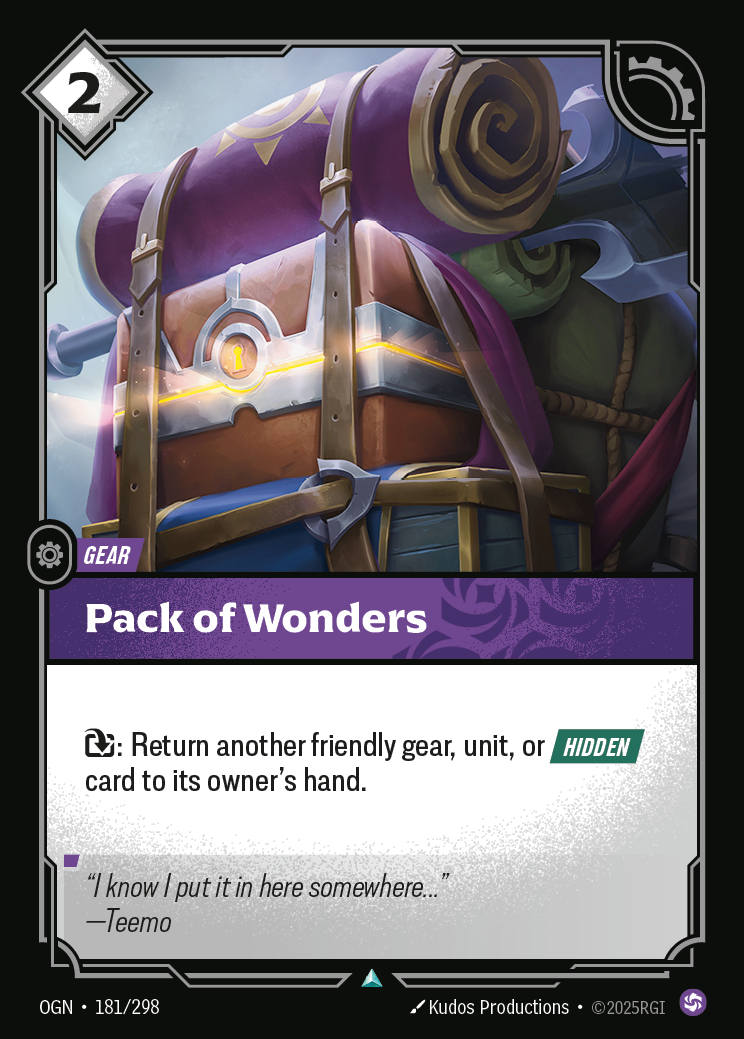
[E]: Return another friendly gear, unit, or facedown card to its owner's hand.
Q: Does this mean it can return a card from my deck to my hand? Those are face down...
No. (Nice try, though.) "Facedown card" always means a card that's hidden facedown on the board unless a card's text specifies otherwise.
Cards that Replace Units Dying
Q: When I replace a unit's death with a card like Unlicensed Armory, does damage on the unit stay? If the unit died to lethal damage, doesn't it just die again?
The intent behind these four cards is to save your unit from dying, whether it died due to direct kill like Hidden Blade or due to lethal damage. To better communicate this, these cards will receive updated wordings. Two of them, Highlander (from the Proving Grounds boxed set) and Unlicensed Armory, have straightforward fixes, adding "heal" and listing "exhaust" and "recall" as separate actions.
Highlander
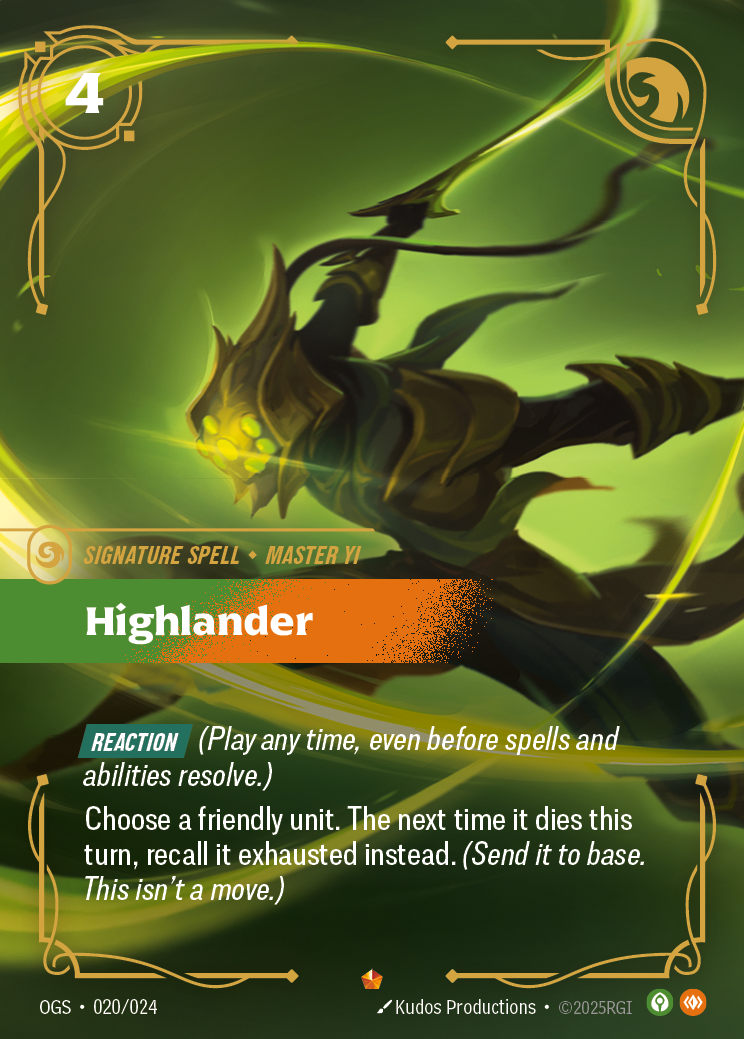
[Reaction] (Play any time, even before spells and abilities resolve.)
Choose a friendly unit. The next time it dies this turn, heal it, exhaust it, and recall it instead. (Send it to base. This isn't a move.)
Unlicensed Armory
Discard 1, [E]: Choose a friendly unit. The next time it would die this turn, you may pay [C] to heal it, exhaust it, and recall it instead. (Send it to base. This isn't a move.)
Zhonya's Hourglass also has a slightly updated wording making it clearer that its ability applies any time a friendly unit dies, not just on the turn you play it.
Zhonya's Hourglass
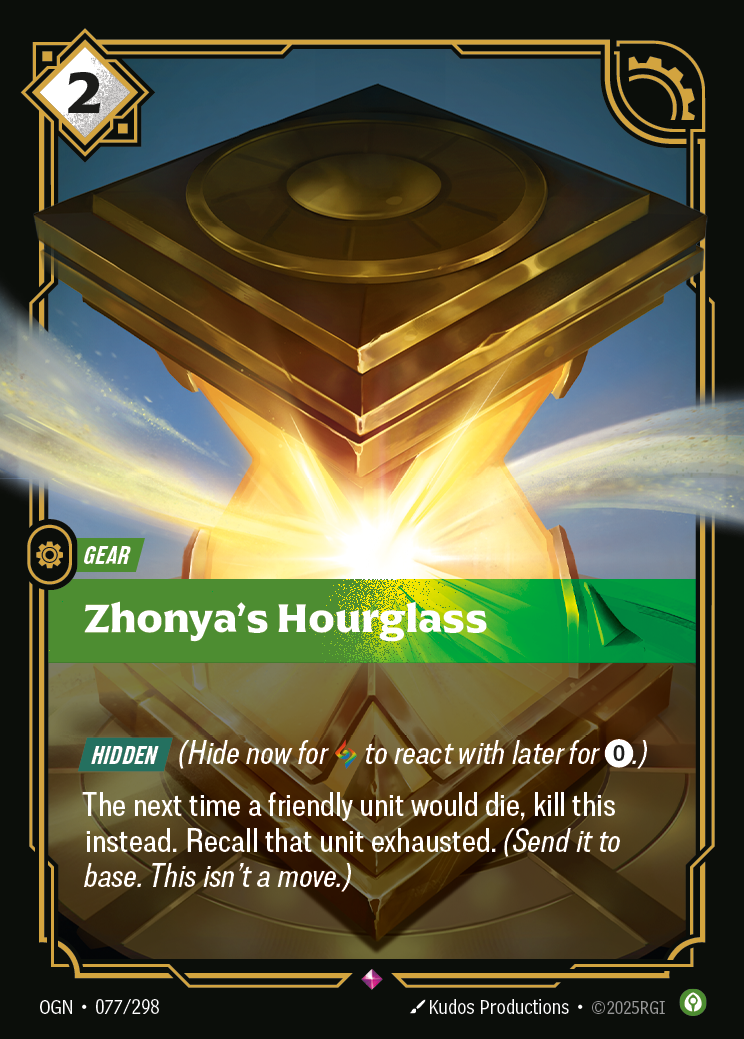
[Hidden] (Hide now for [A] to react with later for [0].) If a friendly unit would die, kill this instead. Heal that unit, exhaust it, and recall it. (Send it to base. This isn't a move.)
The Boss was mistakenly worded like a triggered ability. It's receiving updated wording to make it clear that its ability is a replacement effect.
The Boss (revised text)
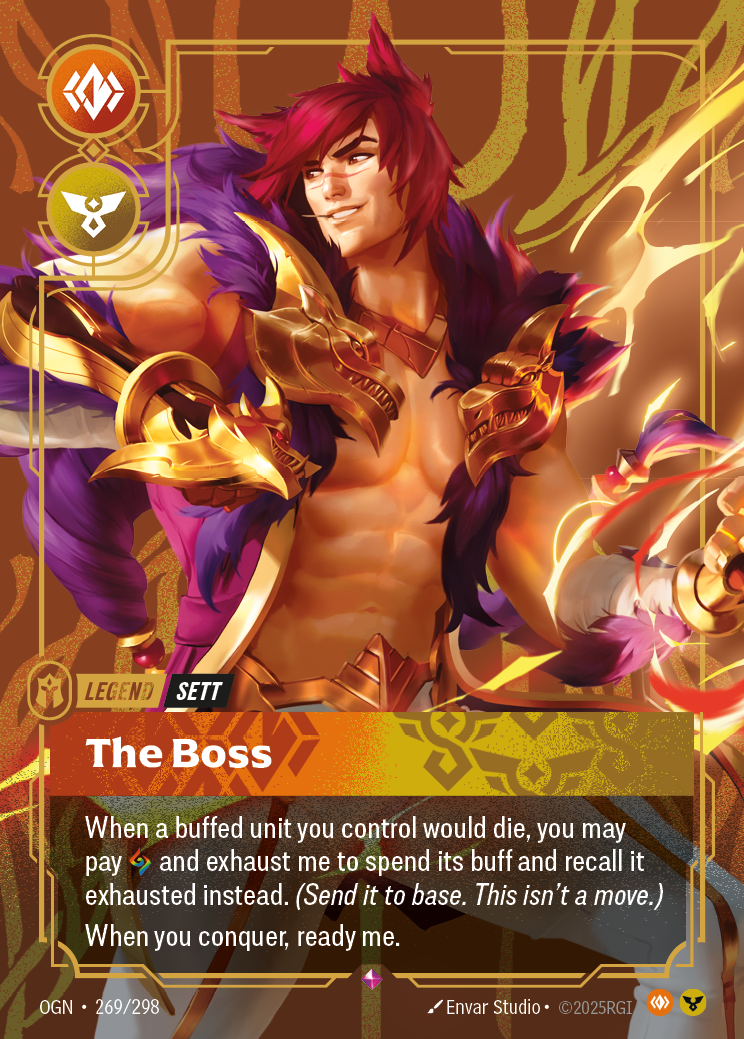
If a buffed unit you control would die, you may pay [C], exhaust me, and spend its buff to heal it, exhaust it, and recall it instead. (Send it to base. This isn't a move.) When you conquer, ready me.
Q: Can I use these cards to save a unit that's already in its base? What about one that's already exhausted? If I can't recall it, do I still exhaust it?
Yes. You can save any unit that meets the description in the replacement ability's condition. For Highlander and Unlicensed Armory, that's any friendly unit. The actions you perform on that unit as a replacement are like the effects of a spell or ability; you'll do as much as you can: heal the unit (if it's damaged), exhaust it (if it's ready), and recall it (if it's somewhere other than its base). And yes, you exhaust the unit even if you don't recall it; as per the above wordings, we've changed the "recall it exhausted" language to make that clearer.
Q: If I play Cruel Patron and kill one of my units for its additional cost, but one of these cards replaces that unit's death, does the cost still count as paid?
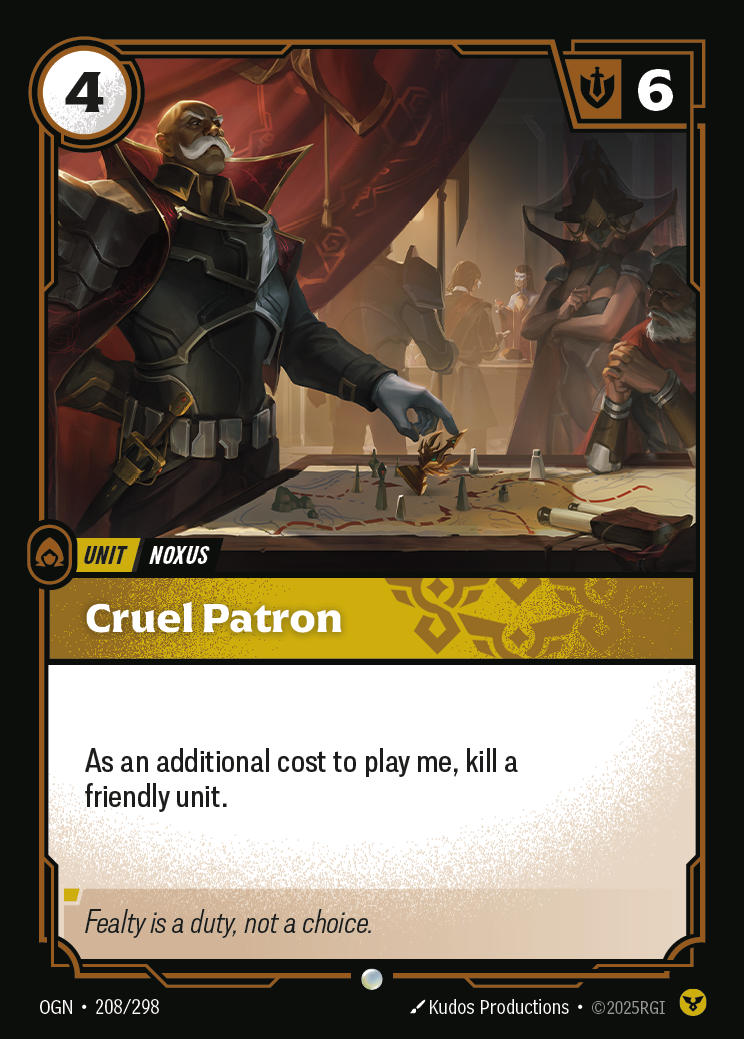
Yes. You made the decision to pay the cost and took the action to pay it. What happened after that doesn't matter.
Q: If a unit would be killed by Hidden Blade, but one of these cards replaces that unit's death, does the unit's controller still draw 2?
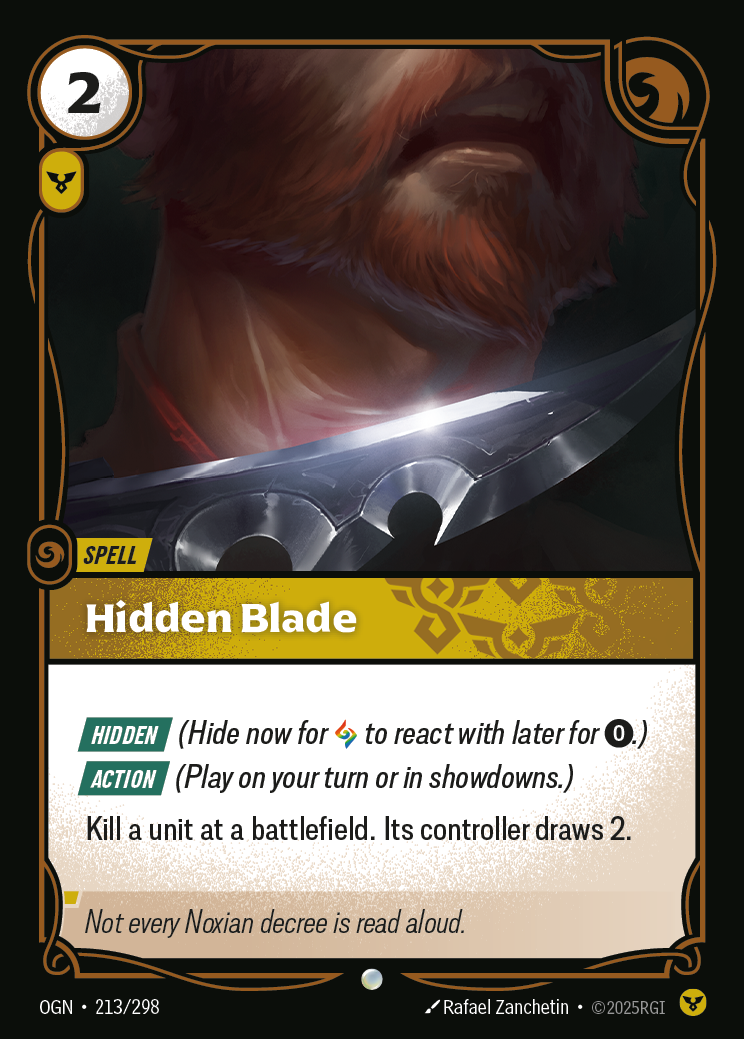
Yes. Hidden Blade attempts to kill a unit, then says that "its controller" draws 2. Even if the unit doesn't die, it's still on the board and information about its controller is still available, so that player draws 2. This is different from Baited Hook, which requests information about "the killed unit," and can't find any information if no unit was actually killed.
Timing of Healing Damage at End of Combat
Q: I have Garen, Commander at a battlefield along with a Recruit token. Thanks to Garen, the Recruit has 2 Might. My opponent's total Might during the combat damage step is 6, so they deal 5 damage to Garen and 1 to the Recruit. Does the Recruit die?
No. Under the revised rules, combat damage is dealt, any units with lethal damage on them are killed, and then units are immediately healed of all damage before lethal damage is checked again.
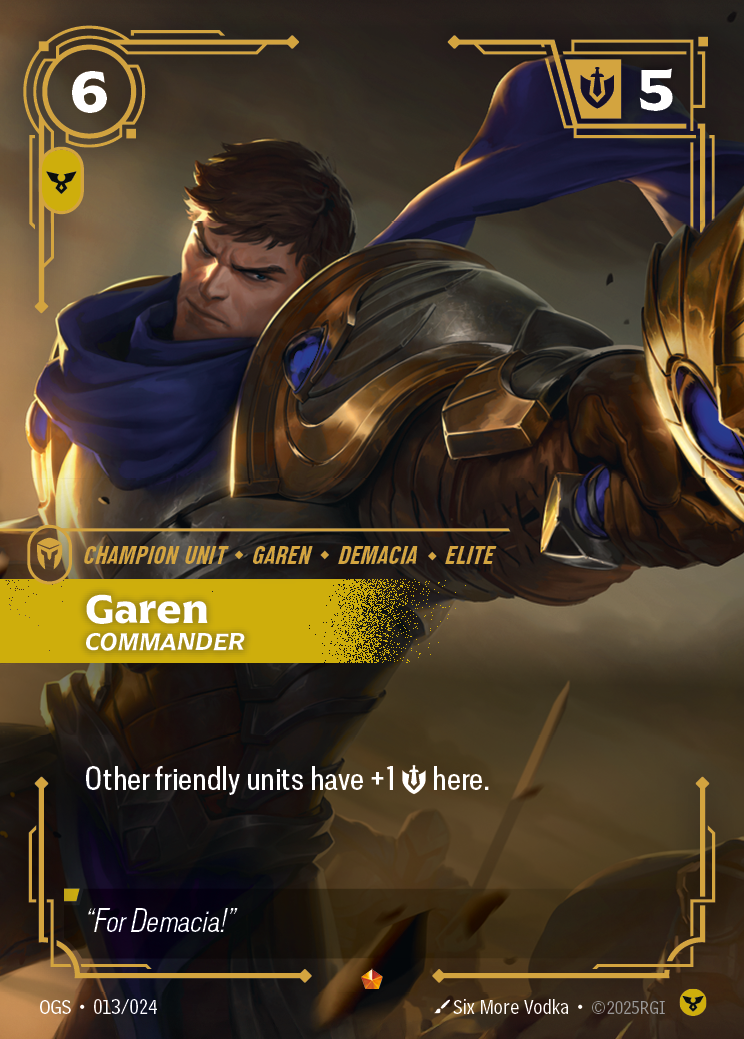
This means that if one of your units that died was providing a Might boost to other units, they're healed of any damage before losing that Might boost. This is a change from previous rulings that impacts cards including Captain Farron; Taric, Protector; Garen, Commander; and Darius, Executioner.
Q: Does the damage from Kog'Maw's Deathknell ability happen before or after combat damage is healed?
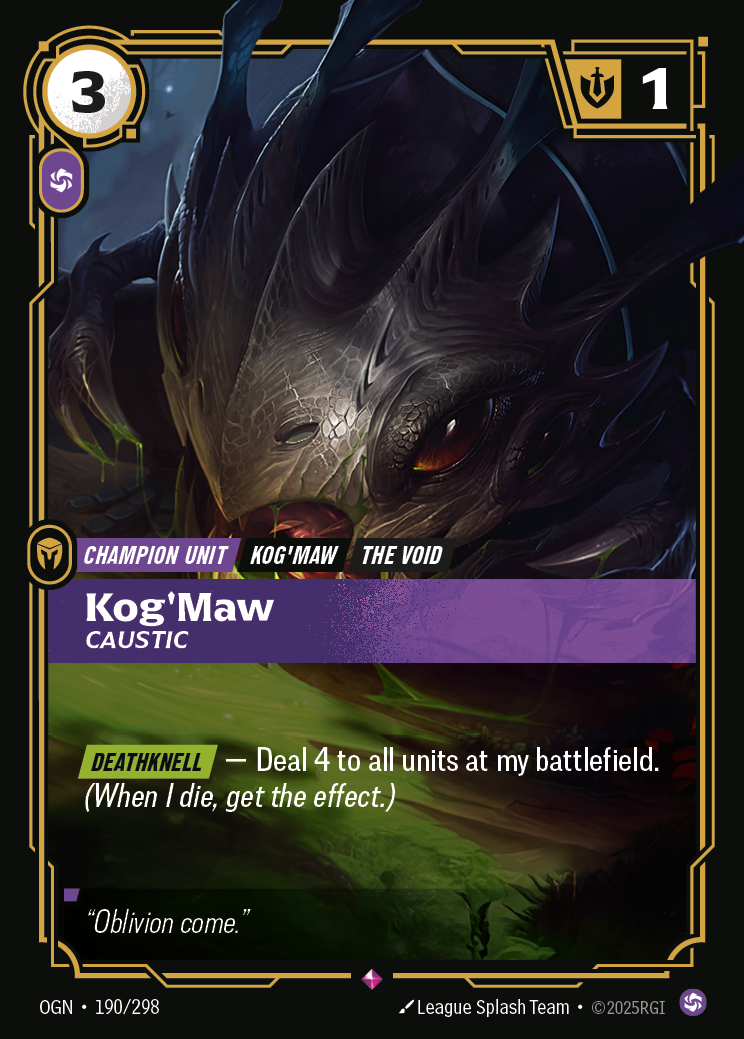
After. Kog'Maw, Caustic has a Deathknell ability that says "Deal 4 to all units at my battlefield." Under the revised rules, all damage currently on units will be healed before Kog'Maw's Deathknell ability resolves. This does mean, however, that any units that survive his Deathknell will still have 4 damage on them after combat, and you can use a spell or another combat to finish them off. This is a change from previous rulings..
Unyielding Spirit
Q: What counts as "spell and ability damage?" What does this card do?
"Spell and ability damage" on Unyielding Spirit is meant to encompass damage dealt by spells and abilities, but not damage dealt by other things as a result of spells or abilities. It will receive errata to clarify this.
Unyielding Spirit
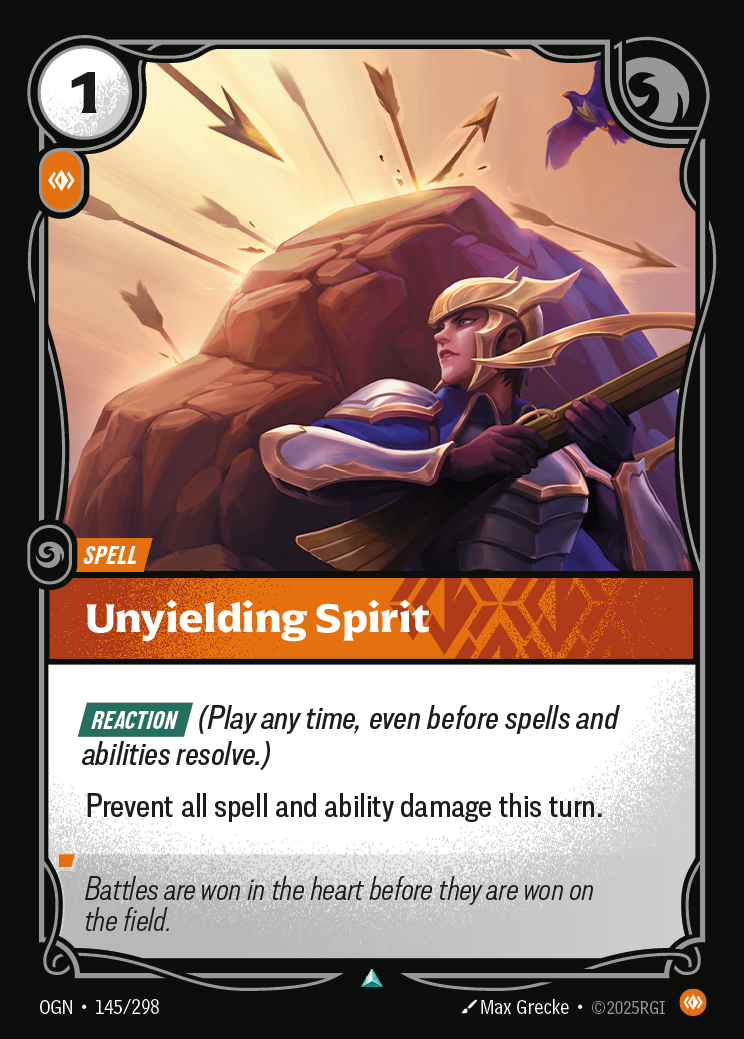
Prevent all damage that would be dealt this turn by spells and abilities.
Q: So... What does this card do?
Most spells and abilities that deal damage just say "Deal 3" or similar. Unyielding Spirit stops damage from all such spells and abilities. Other cards, though, specify a source of the damage.
- Damage dealt by spells is damage that a spell instructs you to deal without specifying that some other object deals it.
- Damage dealt by abilities is damage that an ability instructs you to deal without specifying that some other object deals it. (All damage dealt by abilities is also dealt by the object that's the source of the ability.)
If a spell or ability instructs a particular object to deal damage, including the card the ability is on, then that object is dealing the damage, not the spell or ability. So Unyielding Spirit does stop damage from Void Seeker, Stormbringer, or Yasuo, Remorseless, but does not stop damage from Challenge, Last Breath, or Carnivorous Snapvine.
Immortal Phoenix
Q: What does it mean to "kill a unit with a spell?" It seems like Hidden Blade counts, but what about a spell that deals damage? A spell that causes a unit to deal damage? A spell that causes a unit to die in some other way, like Stupefy on a unit that has 1 more Might than it has damage currently marked on it?
This is unclear under existing rules, so the updated rules will clarify. "When you kill a unit with a spell" triggers immediately after a spell you control resolves if either of the following is true:
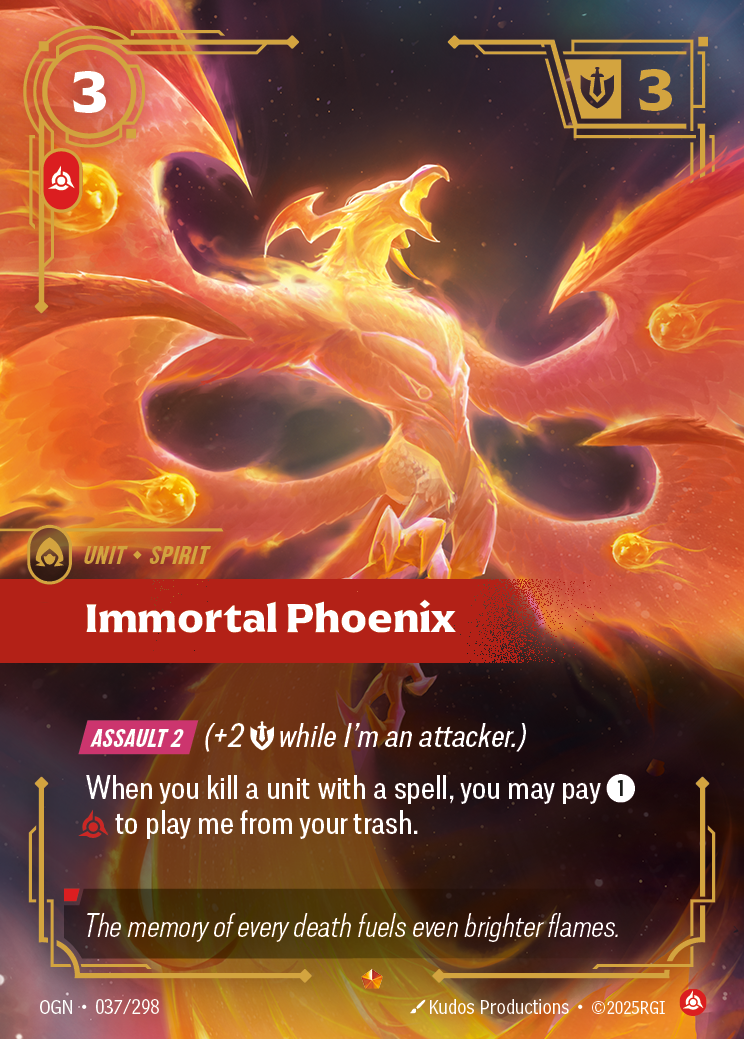
- That spell instructs you to kill a unit during its resolution, and that unit is put into the trash this way.
- A spell instructs you to deal damage to a unit during its resolution, and that unit is put into the trash during the cleanup immediately following that spell's resolution.
This includes "direct kill" spells you control like Hidden Blade. It also includes damage spells like Void Seeker, provided they mark lethal damage on the unit that immediately causes it to die. In all cases, the unit has to actually die-if that death is replaced by a card like Unlicensed Armory, then you didn't kill a unit with a spell.
Notably, the following do not count as you killing a unit with a spell:
- You are instructed to kill a unit by a spell another player controls, even if the spell instructs you to kill
- the unit (e.g., another player's Cull the Weak).
- Another player is instructed to kill a unit by a spell you control (e.g., your Cull the Weak, if you don't kill
- any of your own units with it).
- You play a spell like Challenge that causes a unit to deal lethal damage to another unit.
- You use a spell to mark damage on a unit and the unit dies later in the turn, even if that damage later became
- lethal damage for any reason.
- You use a spell to directly or indirectly lower the Might of a unit, causing damage it's already taken to become
- lethal damage. For example:
- You use a spell like Stupefy to lower the Might of a unit that has already taken damage, causing that
- damage to become lethal damage.
- You use a spell like Charm to move a unit with damage on it away from Trifarian War Camp, indirectly
- lowering its Might and causing that damage to become lethal damage.
- You use a spell like Rebuke to return Lee Sin, Centered to its owner's hand, indirectly lowering the
- Might of a buffed unit at the same battlefield that has damage on it, causing that damage to become
- lethal damage.
- You do anything else with a spell that causes a unit to die in any other way than the two methods listed above,
- or at any time other than during or immediately after the spell's resolution.
- You do any of the above, but the unit doesn't actually die.
Q: Can Immortal Phoenix return if it is the unit that was killed? Or if it and other units were killed at the same time? For example, can I Hidden Blade on my own Phoenix and immediately replay it?
Yes. Triggers like this are evaluated immediately after the event that takes place, at which point Phoenix is in the trash.
Void Gate
Q: If a spell deals damage to one or more units at Void Gate and one or more units somewhere else, which parts of that deal Bonus Damage?
The Bonus Damage from Void Gate is only for damage being dealt to units at Void Gate. It will receive errata to clarify this. (As a bonus, Bonus Damage will now be fully defined in the rules.)
Void Gate (revised text)
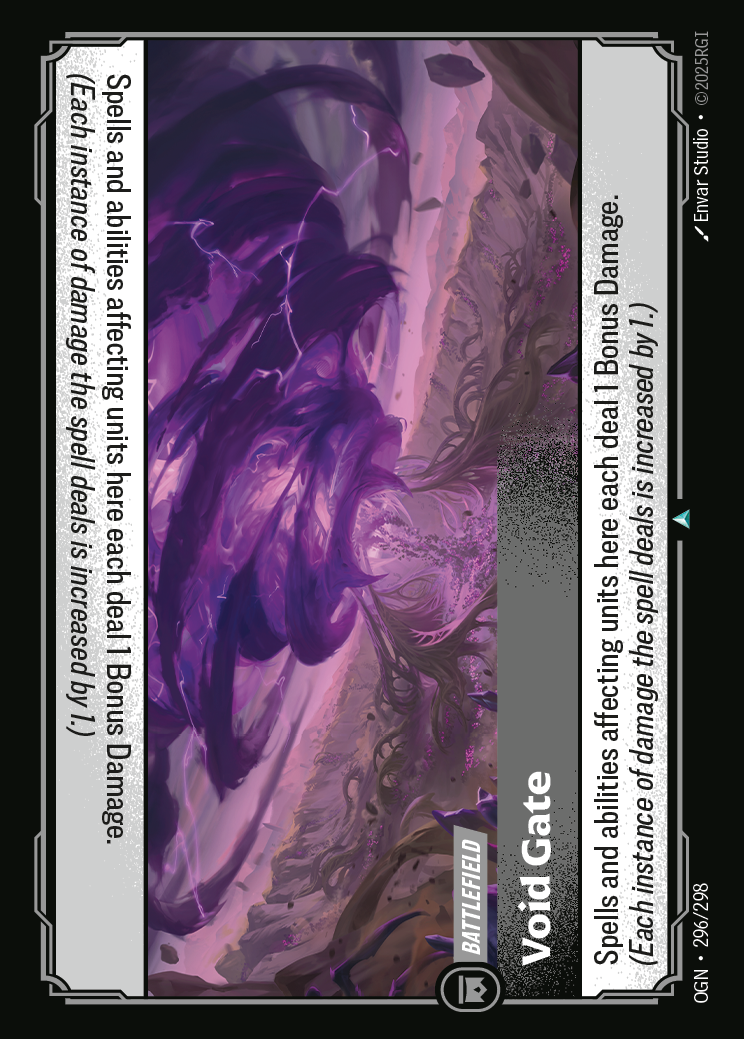
Spells and abilities deal 1 Bonus Damage to units here.
(Each instance of damage the spell deals to a unit here is increased by 1.)
Darius, Trifarian
Q: If I play Darius, Trifarian as my second card in a turn, does he ready and gain 2 Might?
Yes, this works. Triggers like this are evaluated immediately after the event that takes place, at which point Darius is on the board.
Q: If I play Darius as my third card, does he ready and gain 2 Might? What if I play another card after him?
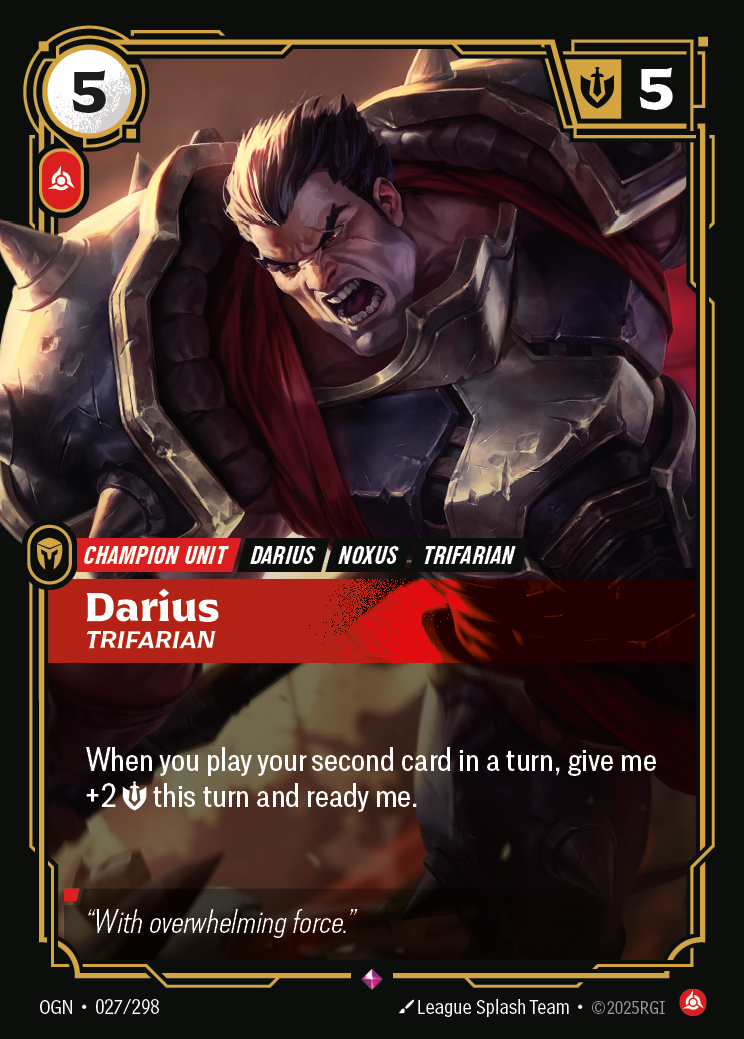
No. If Darius isn't present immediately after you play your second card, he won't trigger that turn.
Hallowed Tomb
Q: Can this card only return the specific card I picked as my Chosen Champion? What about another copy of the same card?
You can return another copy of the same card. Hallowed Tomb refers to "your Chosen Champion," but it's quite possible that you won't be able to verify whether a card in your trash is the specific card you chose. For example, your Chosen Champion might have been played, returned to your hand, and then discarded; you wouldn't be able to prove to your opponent that it wasn't another copy of the same card. Because of this, the updated rules treat all copies of the card you designated as your Chosen Champion as interchangeable.
Q: What about a different card with the same Champion tag? If Jinx, Rebel is my Chosen Champion, can I get back a Jinx, Demolitionist, because Jinx is my Chosen Champion?
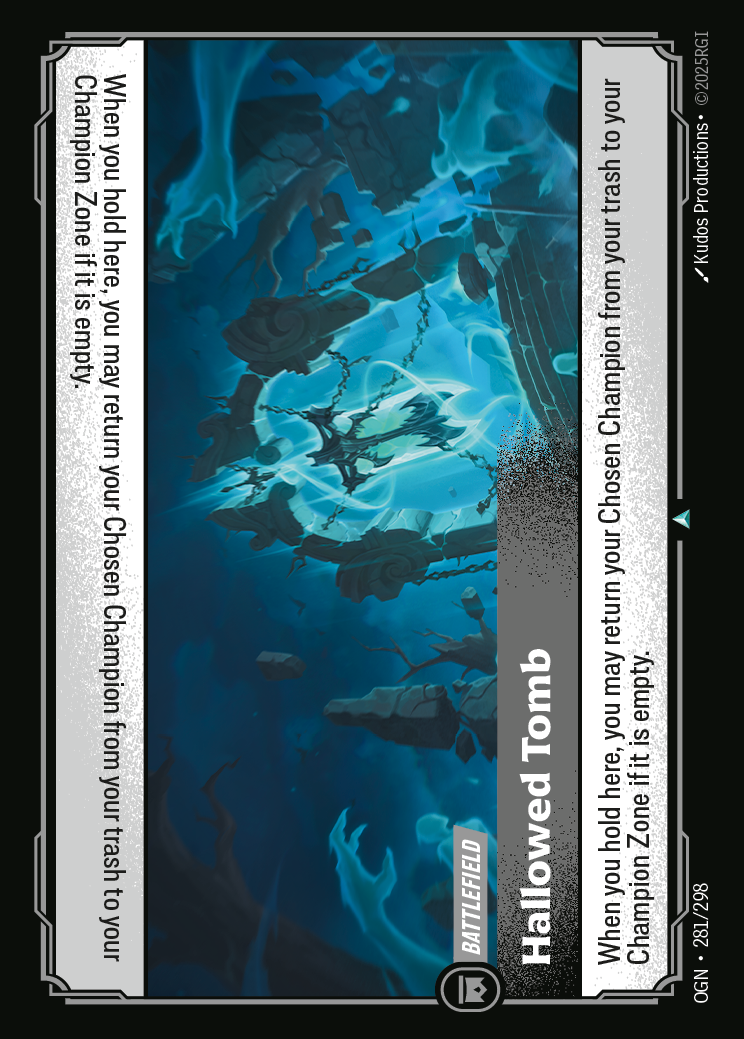
No. You can only get back a card with the exact full card name of the one you chose at the start of the game.
Karma, Channeler
Q: Does Karma trigger off of recycling runes?
No. When the text of Riftbound cards refers to "cards," it means Main Deck cards only. Karma's reminder text reflects this.
Q: Does Karma trigger off of recycling cards into other players' Main Deck due to a card like Sabotage?
No. The updated rules will clarify that regardless of who is instructed to do the recycling in card text, players always recycle their own cards. To reflect this, Karma is receiving errata.
Karma, Channeler (revised text)
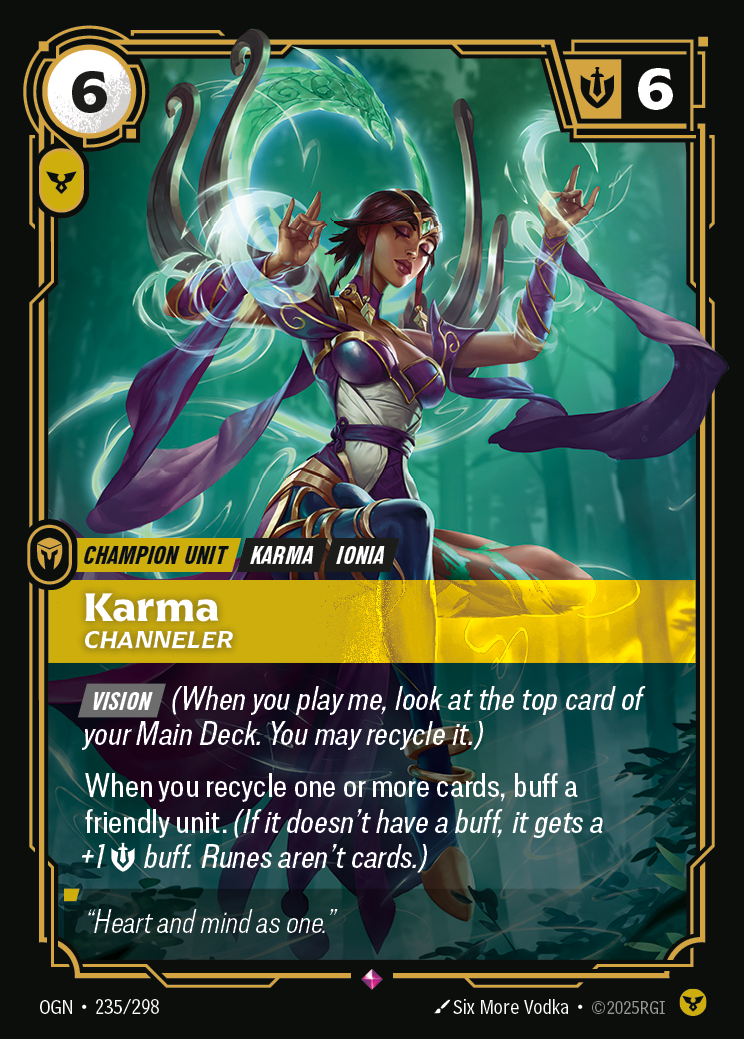
[Vision] (When you play me, look at the top card of your Main Deck. You may recycle it.)
When you recycle one or more cards to your Main Deck, buff a friendly unit. (If it doesn't have a buff, it gets a +1 [M] buff.)
Sun Disc
Q: Can I use Sun Disc's ability the turn I play it, counting itself for its Legion ability?
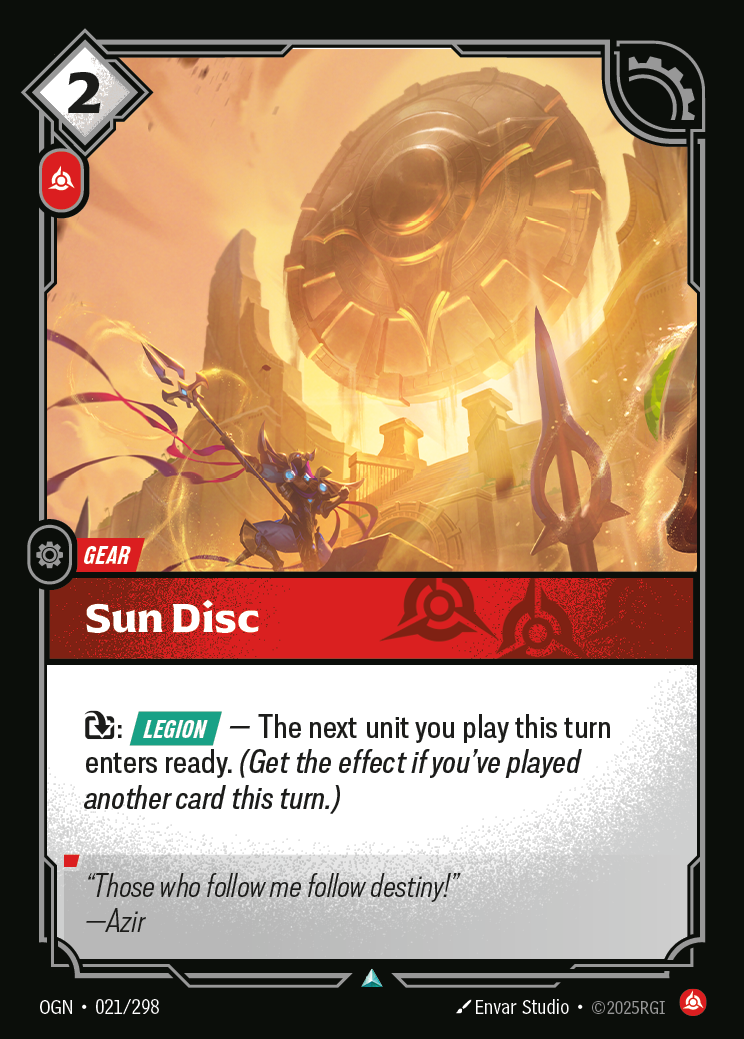
Yes. Although Legion normally requires "another" card for spells and play effects, Sun Disc's activated ability is not Sun Disc. On subsequent turns, you'll need to play another card to turn on Legion.
Symbol of the Solari
Q: What does it mean for combat to be a "tie?"
The updated rules will more clearly define what it means to win, lose, or tie a combat.
- A player wins a combat if only their units are present after combat damage has been dealt.
- -
- A player loses a combat if the other player in combat still has units present and they do not (ie, if the
- other player wins).
- -
- A combat ends in a tie if either:
- -
- Neither player has units left at the battlefield (e.g. they all died to combat damage).
- -
- Both players have units left at the battlefield (e.g. one or more units was ineligible to deal or
- receive combat damage-stunned units, Kayn, etc).
Winning a combat is not the same as conquering, although ordinarily the attacking player must win in order to
conquer. Either the attacker or the defender can win, and each combat either ends in a tie, or has exactly one
winner and one loser.
When combat ends in a tie, all attacking units are recalled to their base and the defender retains control of the
battlefield. This doesn't cause the defender to win the combat; it's too late for that.
Q: Does Symbol of the Solari recall all units everywhere?
No, just the units that were involved in the tie. It's receiving minor errata to clarify this.
Symbol of the Solari
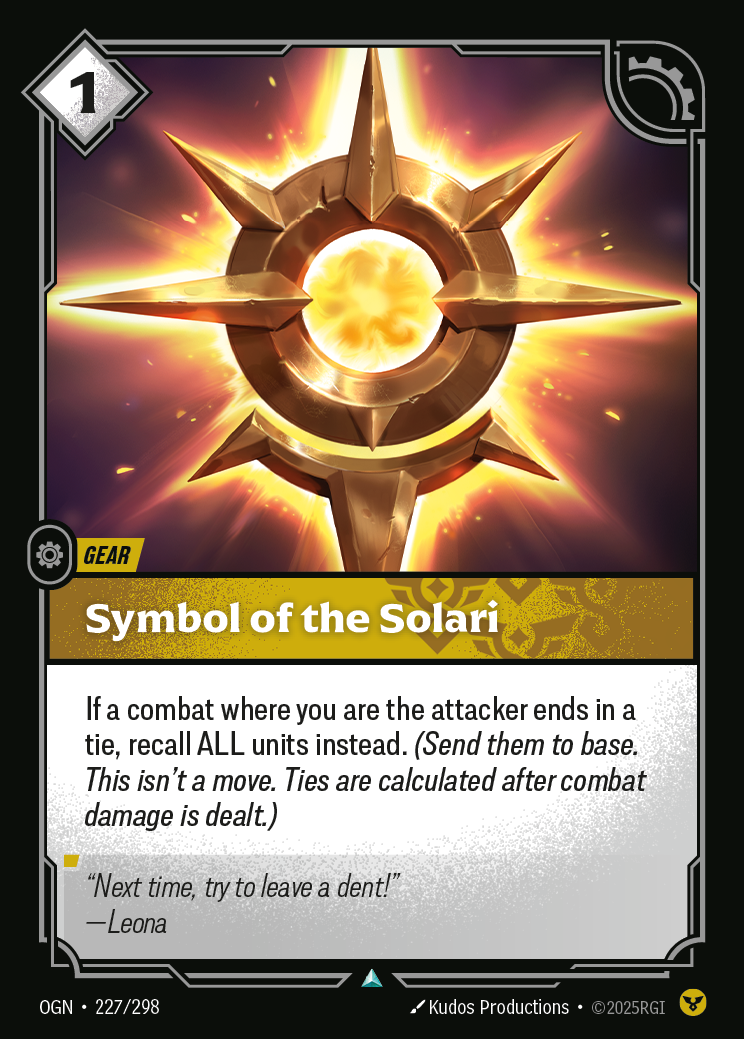
If a combat where you are the attacker ends in a tie that would recall any of your units, recall all units at that battlefield instead. (Send them to base. This isn't a move. Ties are calculated after combat damage is dealt.)
Q: So what does Symbol of the Solari do?
Symbol of the Solari has a replacement effect that applies to a combat if 1) you are the attacker, and 2) the combat ends in a tie because both players have units remaining. Ordinarily this would result in your units being recalled and the defender retaining control, but Symbol of the Solari instead causes all units at that battlefield to be recalled, leaving the battlefield open and uncontested.
Teemo, Strategist
Q: What does this card do, and when can it do it? If I play him from Hidden during combat, does his ability trigger twice?
We're issuing a rules update that changes how Teemo and other defend and attack triggers work, and we're issuing a minor errata for Teemo in accordance with it. We're also clarifying what his ability does and how many targets it has. This contradicts some previous guidance we've given on this card, as we've examined what it says, what it's intended to do, and what our rules can support.
Teemo has a "when I defend" trigger. Under previous rules, attack and defend triggers happened only at the beginning of combat. Teemo's dual trigger condition was meant to cover this-he either triggered at the beginning of combat, or he triggered when you played him into combat.
Teemo, Strategist (revised text)
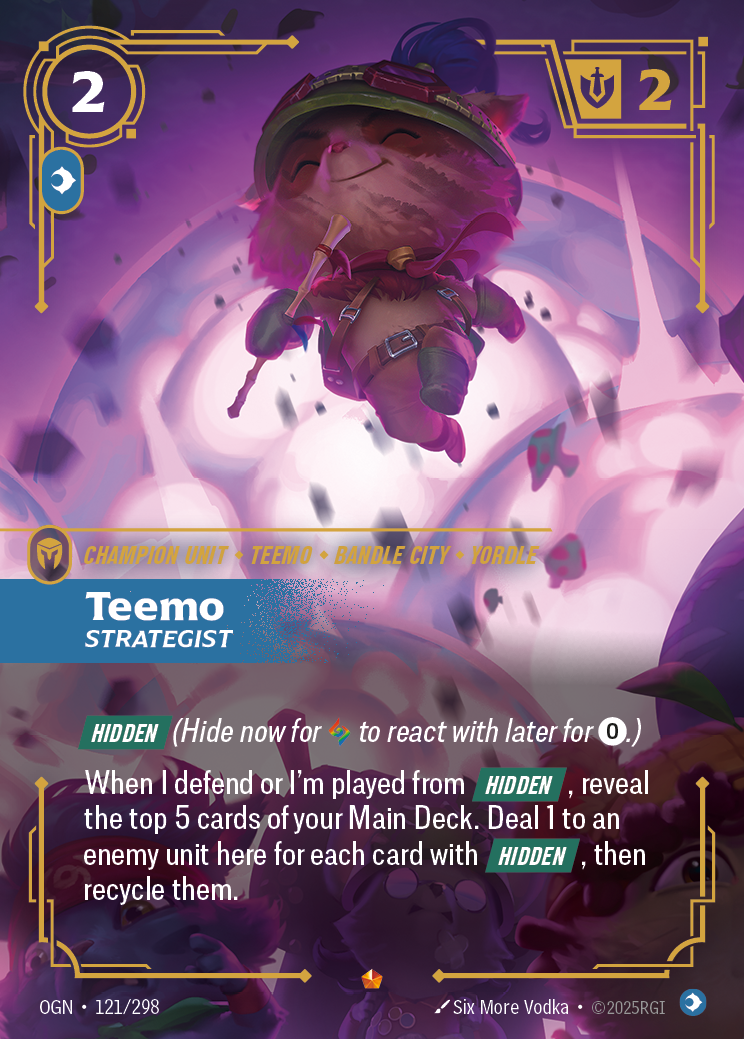
[Hidden] (Hide now for [A] to react with later for [0].)
When I defend, choose an enemy unit here and reveal the top 5 cards of your Main Deck. Deal 1 to that unit for each card with [Hidden] revealed this way, then recycle the revealed cards.
Under the updated rules, attack and defend triggers trigger any time a unit becomes an attacker or defender-whether that's because combat began, because the unit was moved into combat using a spell or ability, or because the unit was played into combat somehow. (And yes, this means that a unit that starts in combat, moves out somehow, and then moves back can trigger these abilities twice. We think this is fine-moving a unit at Action speed isn't easy to do, and doing it twice is even harder, so we don't mind there being a substantial reward.)
One thing to note about this change that doesn't apply to Teemo directly: Assault and Shield are not attack or defend triggers, so they'll work the same way they did before. They apply while a unit is an attacker or defender in combat as appropriate, stop applying once the unit is no longer in combat, and start applying if it joins or rejoins combat partway through. This rules change makes the "played from [Hidden]" part of Teemo's text redundant. And since the ability only does anything if enemy units are present, we're issuing errata to clarify that it only triggers once as intended, whether Teemo is played into combat or was there from the start. We're also rephrasing the ability to make it clearer that it only has one target.
Q: How many enemy units do I target with Teemo, and when do I choose them?
Teemo has only a single target, an enemy unit, chosen when his triggered ability is placed on the chain. That ability will deal a variable amount of damage to that unit based on how many units with Hidden you reveal. This is a change from previous rulings.
Q: Which cards count for Teemo? Does Ember Monk count? What about Noxus Saboteur?
Teemo counts cards that have the Hidden keyword, but not cards that mention Hidden but don't actually have it. Ember Monk and Noxus Saboteur do not have the Hidden keyword.
Wraith of Echoes
Q: Does Wraith of Echoes trigger on its own death?
No. Units don't "see" themselves die unless they have an ability such as Deathknell that explicitly allows them to. For clarity, we are issuing an errata that adds the word "another" to Wraith of Echoes.
Wraith of Echoes
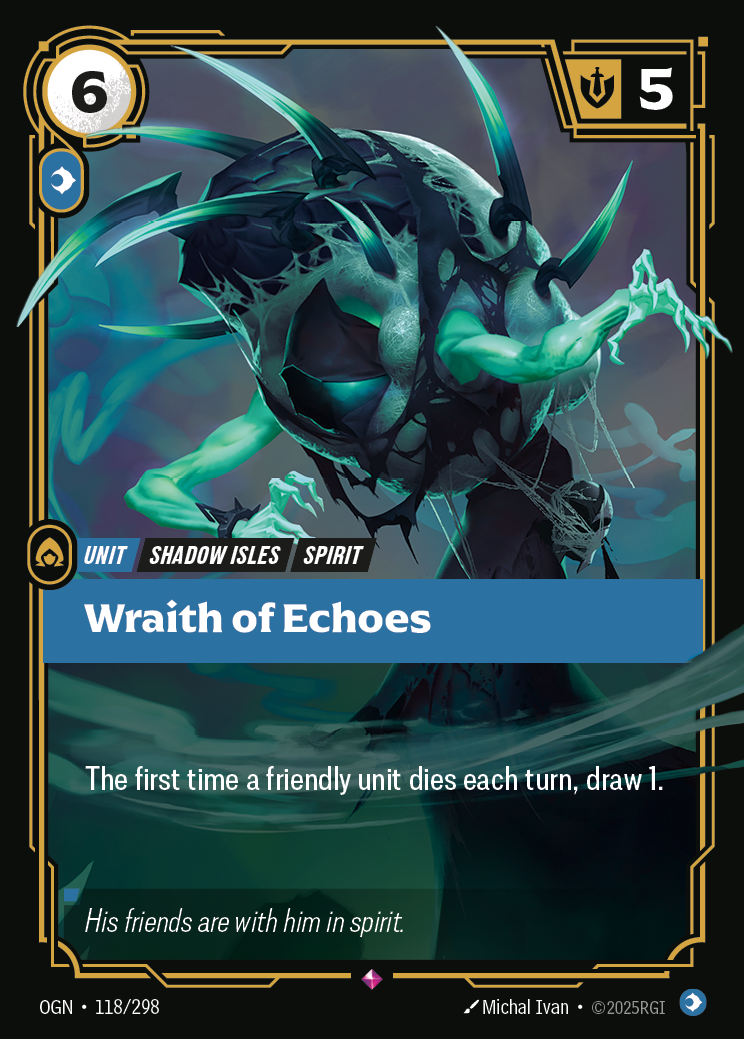
The first time another friendly unit dies each turn, draw 1.
Q: What about other units that die at the same time as Wraith of Echoes, such as to a mass damage spell like Unchecked Power?
No. Units that die also don't "see" anything else that dies at the same time they do.
Q: What happens if the first time a unit dies in a turn is actually two or more units dying simultaneously? Does it trigger twice?
Just once. If an ability triggers "the first time" something happens and that trigger condition is met multiple times simultaneously, you'll pick one to count as the first.