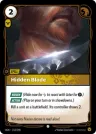
Hidden Blade (Repeated)
If both instances of the repeated Hidden Blade are targeting the same unit, you draw two cards total. As the card resolves, the repeated effect does not have a legal target, so no additional effect occurs.
Full card detail
OGN-213/298 · Origins · Common
[Hidden] (Hide now for [A] to react with later for [0].) [Action] (Play on your turn or in showdowns.) Kill a unit at a battlefield. Its controller draws 2.
Verified Sources
Only passages matched to this card are shown below.
Hidden Blade (Repeated)
If both instances of the repeated Hidden Blade are targeting the same unit, you draw two cards total. As the card resolves, the repeated effect does not have a legal target, so no additional effect occurs.
The intent behind these four cards is to save your unit from dying, whether it died due to direct kill like Hidden Blade or due to lethal damage. To better communicate this, these cards will receive updated wordings. Two of them, Highlander (from the Proving Grounds boxed set) and Unlicensed Armory, have straightforward fixes, adding "heal" and listing "exhaust" and "recall" as separate actions.
Q: If a unit would be killed by Hidden Blade, but one of these cards replaces that unit's death, does the unit's controller still draw 2?
Yes. Hidden Blade attempts to kill a unit, then says that "its controller" draws 2. Even if the unit doesn't die, it's still on the board and information about its controller is still available, so that player draws 2. This is different from Baited Hook, which requests information about "the killed unit," and can't find any information if no unit was actually killed.
Q: What does it mean to "kill a unit with a spell?" It seems like Hidden Blade counts, but what about a spell that deals damage? A spell that causes a unit to deal damage? A spell that causes a unit to die in some other way, like Stupefy on a unit that has 1 more Might than it has damage currently marked on it?
This is unclear under existing rules, so the updated rules will clarify. "When you kill a unit with a spell" triggers immediately after a spell you control resolves if either of the following is true:
- That spell instructs you to kill a unit during its resolution, and that unit is put into the trash this way.
- A spell instructs you to deal damage to a unit during its resolution, and that unit is put into the trash during the cleanup immediately following that spell's resolution.
This includes "direct kill" spells you control like Hidden Blade. It also includes damage spells like Void Seeker, provided they mark lethal damage on the unit that immediately causes it to die. In all cases, the unit has to actually die-if that death is replaced by a card like Unlicensed Armory, then you didn't kill a unit with a spell.
Notably, the following do not count as you killing a unit with a spell:
- You are instructed to kill a unit by a spell another player controls, even if the spell instructs you to kill the unit (e.g., another player's Cull the Weak).
- Another player is instructed to kill a unit by a spell you control (e.g., your Cull the Weak, if you don't kill any of your own units with it).
- You play a spell like Challenge that causes a unit to deal lethal damage to another unit.
- You use a spell to mark damage on a unit and the unit dies later in the turn, even if that damage later became lethal damage for any reason.
- You use a spell to directly or indirectly lower the Might of a unit, causing damage it's already taken to become lethal damage. For example:
- You use a spell like Stupefy to lower the Might of a unit that has already taken damage, causing that damage to become lethal damage.
- You use a spell like Charm to move a unit with damage on it away from Trifarian War Camp, indirectly lowering its Might and causing that damage to become lethal damage.
- You use a spell like Rebuke to return Lee Sin, Centered to its owner's hand, indirectly lowering the Might of a buffed unit at the same battlefield that has damage on it, causing that damage to become lethal damage.
- You do anything else with a spell that causes a unit to die in any other way than the two methods listed above, or at any time other than during or immediately after the spell's resolution.
- You do any of the above, but the unit doesn't actually die.
Q: Can Immortal Phoenix return if it is the unit that was killed? Or if it and other units were killed at the same time? For example, can I Hidden Blade on my own Phoenix and immediately replay it?
Yes. Triggers like this are evaluated immediately after the event that takes place, at which point Phoenix is in the trash.
What happens when my opponent plays Hidden Blade targeting my Akali, Deadly Weapon in reaction to her move trigger? Will it still deal damage to the chosen unit?
It will.
Akali is another case where her ability refers to information implicit to its own trigger condition, similar to Iascylla. Akali's "battlefield I moved to or from" doesn't require her to be on the board in order for us to be able to identify it, nor does it reference information about her current state. Even if she leaves the board, that information was checked when her ability triggered, and it is still available to us on resolution.
Relevant Rules: 359.3.f.3.
In short, the linked instructions rules are too expansive currently on what qualifies as an "ignored" instruction. To clarify this definition: an ignored instruction is one that wasn't performed as part of the execution of a spell or ability's instructions because it mistargeted (i.e. because the targeted object wasn't a legal target on resolution). This is a case where, for example, you play Hidden Blade choosing an enemy unit and they play Star-Crossed in reaction, returning their unit to hand. When Hidden Blade resolves, the unit isn't on the board, so we ignore the "Its controller draws 2." instruction. Alternatively, if Hidden Blade is given the Repeat keyword by the Academy and both executions target the same unit, this is the reason why the unit's controller doesn't draw 4 cards.
- If a unit at a battlefield says "I can't be killed." and a player plays Hidden Blade choosing that unit, the unit's controller will still draw 2 on resolution of Hidden Blade. (The instruction was negated and not ignored, so the linked instruction will still execute.) - If a unit at a battlefield is chosen by Hidden Blade and in reaction its controller plays Flash moving it to base, that unit's controller will not draw 2 on resolution of Hidden Blade. (The instruction was ignored, so any linked instructions will be ignored.) - If a unit at a battlefield is chosen by Hidden Blade and in reaction its controller plays Zhonya's Hourglass, that unit's controller will draw 2 on resolution of Hidden Blade. (The unit is on the board and can have its information checked, and the instruction was negated and not ignored.) - If a unit at a battlefield has been affected by Smite previously this turn and it is chosen by Hidden Blade, that unit's controller will not draw 2 on resolution of Hidden Blade. (Although the instruction is executed, the unit is not on the board to have its information checked. Additionally, the unit was moved to a non-board zone by an effect other than Hidden Blade and thus no longer has a controller that Hidden Blade can reference.)
359.3.e.5. If any of the spell's targets are no longer legal, those game objects, players, or zones are unaffected by the spell as it resolves. Any instructions related to an illegal target can't be followed. Example: A player plays Void Seeker, a spell that says "Deal 4 to a unit at a battlefield. Draw 1." The unit's controller uses a Reaction to move the unit to their base. Since the unit is no longer a legal target, it is not dealt any damage. Void Seeker's controller still draws 1. Example: A player plays Bellow's Breath targeting a unit in combat that reads in part "I can't be chosen by enemy spells and abilities unless I'm in combat." In reaction, that unit's controller plays Flash, moving the unit to their base. The unit is no longer in combat, so it is no longer a legal target for Bellow's Breath. The unit will be unaffected by Bellow's Breath as it resolves. Example: A player plays Hidden Blade from the facedown zone at a battlefield, targeting an enemy unit. In reaction to Hidden Blade, their opponent plays Tideturner from facedown at another battlefield, choosing to swap locations with the unit Hidden Blade targeted. When Hidden Blade resolves, the chosen unit is no longer at the appropriate battlefield, so any instructions related to that unit are ignored.
359.3.e.14. Some instructions may reference Game Objects affected by, or Game Actions performed in, other instructions in a card. The referenced and referencing instructions are called "linked instructions." Example: Hidden Blade reads "Kill a unit at a battlefield. Its controller draws 2." The "its" in the second instruction references the unit in the first, so the two instructions of the spell are linked.
359.3.e.14.a. In order for a later linked instruction to execute, its earlier linked instruction must have executed. If the earlier linked instruction is ignored for any reason, the later linked instruction will also be ignored. Example: Hidden Blade reads "Kill a unit at a battlefield. Its controller draws 2." If the chosen unit changes zones or moves to base in reaction to Hidden Blade, the spell will mistarget and the first instruction will be ignored. If the first instruction is ignored, the second instruction will not execute and the unit's controller will not draw 2.
359.3.e.14.b. If the Game Action performed in an earlier linked instruction is replaced, this will not affect the later linked instruction, unless the later linked instruction directly references the Game Action being performed. Example: Hidden Blade reads "Kill a unit at a battlefield. Its controller draws 2." This effect is split into two instructions: killing the unit and the targeted unit's controller drawing 2. The later linked instruction doesn't reference an action directly, so it will execute even if the kill action of the earlier linked action is replaced by some other event. Example: Deathgrip reads "Kill a friendly unit. If you do, give +[M] equal to its Might to another friendly unit this turn." If the friendly unit in question is not killed by Deathgrip because its death is replaced with another event, the later linked instruction will not execute because "if you do" directly references the game action.