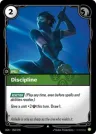
479. To determine which effect Depends on another, determine which of the prior criteria applies, and then also which effect's evaluation is altered by the sequence of applications. That effect is said to Depend on the other. Example: A unit with 4 [M] is under the effects of a passive ability that reads "Units you control here have their Might increased to 5 [M]." Its controller plays Discipline on the unit, giving it +2 [M]. When applying Layer alterations, both effects are applied in the same layer. If we apply the passive ability first, the passive ability will give +1 [M] while the Discipline effect will give +2 [M]. If we apply them in the other order, the Discipline effect will give +2 [M], and the passive ability will give +0 [M]. The passive ability is altered by the sequence of applications, so it depends on the Discipline effect.
Full card detail
Discipline
OGN-058/298 · Origins · Uncommon
- Energy
- 2
- Might
- -
- Power
- -
Ability
[Reaction] (Play any time, even before spells and abilities resolve.) Give a unit +2 [M] this turn. Draw 1.
Verified Sources
Official references
Only passages matched to this card are shown below.
5Related Rules
479.2. To resolve a dependency, the effects within the same layer that created the dependency must be applied such that: 1. Identify which effect Depends on the other within the Layer. 2. Apply the effect that is depended on first. 3. Immediately apply the effect that Depends on the first effect next. Example: A unit with 4[M] is under the effects of a passive ability that reads "Units you control here have their Might increased to 5 [M]." Its controller plays Discipline on the unit. As previously established, the passive ability depends on the Discipline effect. We apply the Discipline effect first, giving the unit +2 [M], and then immediately apply the passive ability that depends on it. The unit's final Might is 6 [M].
758.2. If the spell or ability changes for any reason such that it will no longer fall under the category of spells or abilities for which a Game Object is untargetable, the Game Object will become a legal target for that spell or ability. Example: A 1 [M] unit reads "I can't be chosen by enemy spells or abilities with Energy cost less than my Might." That unit is targeted by an enemy Falling Star; in reaction to the Falling Star, the unit's controller plays Discipline targeting that unit, bringing its Might to 3 [M]. If Falling Star resolved at that point, the unit would be unaffected by it as it resolves. Falling Star's controller plays Eclipse before Falling Star resolves, bringing the unit's Might to -1 [M]. When Falling Star resolves now, the unit is affected by the spell and has 6 damage marked. It dies in the following cleanup.
758.2.a. This will also occur if the Game Object is no longer among the set of objects that are made untargetable by a Game Effect. Example: Alpha Wildclaw and Vilemaw are controlled by the same player and located at a battlefield. An opponent targets Vilemaw with Rebuke. Before Rebuke resolves, Vilemaw's controller plays Discipline targeting Alpha Wildclaw, making Vilemaw no longer a legal target. Rebuke's controller then targets Alpha Wildclaw with Star-Crossed. When Star-Crossed resolves, Alpha Wildclaw's passive ability no longer applies to Vilemaw, making it a legal target for Rebuke. After all spells and abilities have resolved, both Vilemaw and Alpha Wildclaw will be returned to hand.
509.4.a.1. A player plays Discipline indicating a unit. They immediately change their mind and choose a different unit, or choose not to play the Discipline at all.